Truth and Reconciliation Day events confront residential school denialism
Indigenous leaders and survivors marked the day by calling for a renewed commitment to listening as denialism persists.
Explainer
Hundreds gathered in New Westminster's Queen's Park on Wednesday for an event marking the National Day for Truth and Reconciliation that speakers emphasized was not a celebration.
"Maybe one day it will be a celebration," said William Nelson, a residential school survivor whose Indigenous name can't be spelled in English.
READ MORE: Events and closures mark National Day for Truth and Reconciliation across Canada
READ MORE: Manitoba premier opposes criminalizing residential school denialism
"But now was the time to remember those who suffered at the schools."
He recounted not being allowed to speak his language or engage in Indigenous practices.
Nelson and another speaker, Cliff White, also known as Ma’Awta from the Gitxaała Nation, spoke of the need to keep witnessing their stories, especially after reports of white supremacists rallying in Kamloops last week.
Why are Indigenous leaders speaking out against denialism?
In Calgary, Indigenous leaders called for a renewed commitment to listening to survivors as denialism continues in public conversation.
Phil Fontaine, former national chief of the Assembly of First Nations, spoke at the University of Calgary.
"It’s never easy to talk about abuses experienced by so many in residential schools, but it must be told over and over again, so that people understand that this is not a myth," Fontaine said.
"The residential school experience is real and for many of the survivors alive, it’s an enduring pain."
His talk came a day after a debate on campus, hosted by Canadian Students for Free Speech, asked whether residential schools constituted genocide.
Verity Turpin, U of C’s vice-provost of student and campus experience, condemned that event.
"It was both deeply hurtful and harmful," she said.
Calgary Mayor Jeromy Farkas also addressed denialism at a city Orange Shirt Day program.
"The truth matters, no matter how many small fringe voices exist in our community who deny those graves and deny the pain," Farkas said.
"This does not happen somewhere else, it happened here in Canada, in Alberta, and yes, in Calgary."
How did survivors describe the ongoing impacts?
In New Westminster, Albert Wesley, of the Nisga’a and Tsimshian Nations, spoke of growing up with two parents who attended residential schools.
"There was alcohol, there was domestic violence, there was instability," he said.
"When I was a child, I didn’t know the term intergenerational trauma. I didn’t understand residential school policy. I didn’t understand colonization."
Wesley said his parents were separated from their families and he later lost his own children to the Ministry of Families and Children for two years.
"When I look back, there is a connection that is difficult to ignore," he said.
He now works helping others deal with the ministry.
"Orange shirts are important, ceremonies and acknowledgements are important. But the reconciliation has to continue when Sept. 30 is over," Wesley said.
He said reconciliation requires relationships with non-Indigenous people who are "willing to listen to their uncomfortable history without becoming defensive."
How was the day marked in other communities?
In Mînî Thnî, near Cochrane, nearly 200 people took part in the annual Truth and Reconciliation walk.
Organizer Eve Powder started the walk six years ago with about 20 people.
"We all bleed the same colour," Powder said. "Every community, every race, we should all respect each other and get to know each other and ask questions."
Her cousin, Kenny Hunter, an Indigenous hospital liaison, said denialism is part of a broader effort to undermine Indigenous people.
"There’s a lot of people out there that are still attacking our way of life, our culture, and even what’s happened in the residential schools," Hunter said.
In Ottawa, a national commemorative gathering was held on the parliamentary front lawn, featuring speeches from survivors, elders and Indigenous leaders.
Governor General Louise Arbour participated in the re-raising of the Survivors’ Flag and attended the gathering.
Prime Minister Mark Carney marked the day in Edmonton, where he attended and delivered remarks at a morning event.
In the St. Clair Catholic District School Board in Ontario, students wore orange shirts, attended healing walks and listened to survivors share their stories.
Some senior students attended a screening of the film Meadowlarks, which tells the story of four Cree siblings separated during the Sixties Scoop.
Anneliese von Kanel, also known as Satoya from the Squamish Nation, drummed and sang with her teen son in New Westminster.
As a ‘60s Scoop child, she only recently learned of her Indigenous heritage and is sharing it with her child.
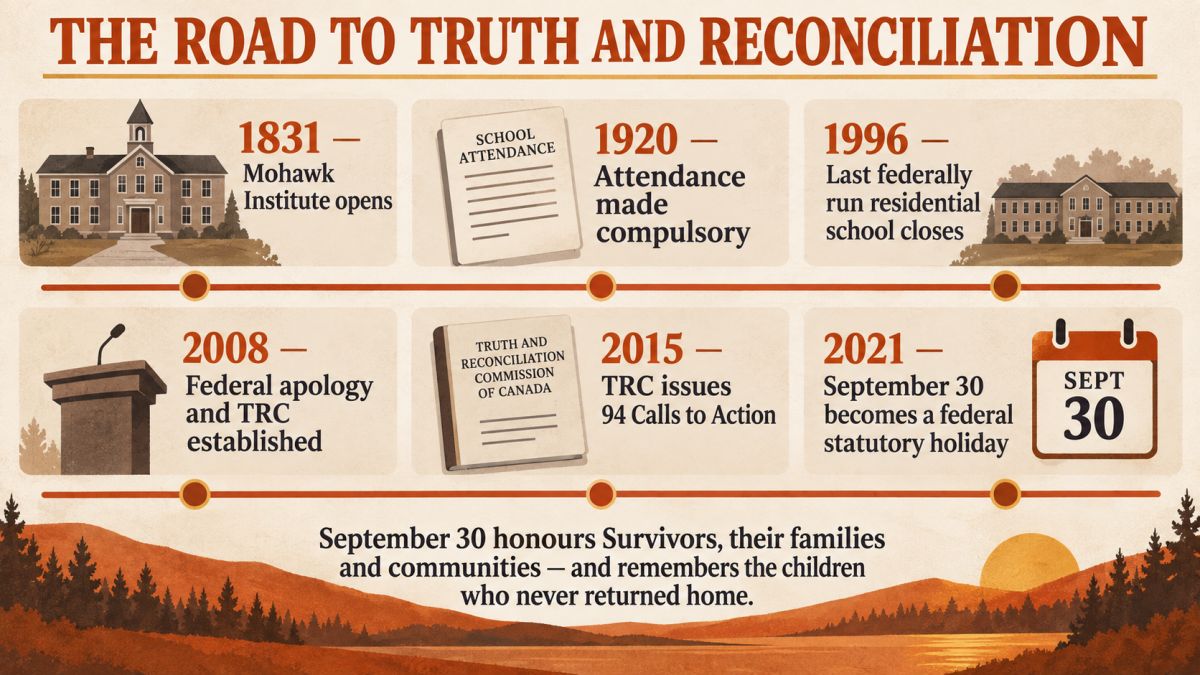
Nelson and White said there is still denialism expressed about the death of children at the 140 schools, the last of which closed in 1996.
The National Commission of Truth and Reconciliation first documented the number of children who died at 3,200, and commissioner Murray Sinclair later said the number was likely higher than 6,000.
"If we expect reconciliation to be achieved, we have to know the truth," Fontaine said.
With files from Vancouver Sun, Calgary Herald and iPolitics