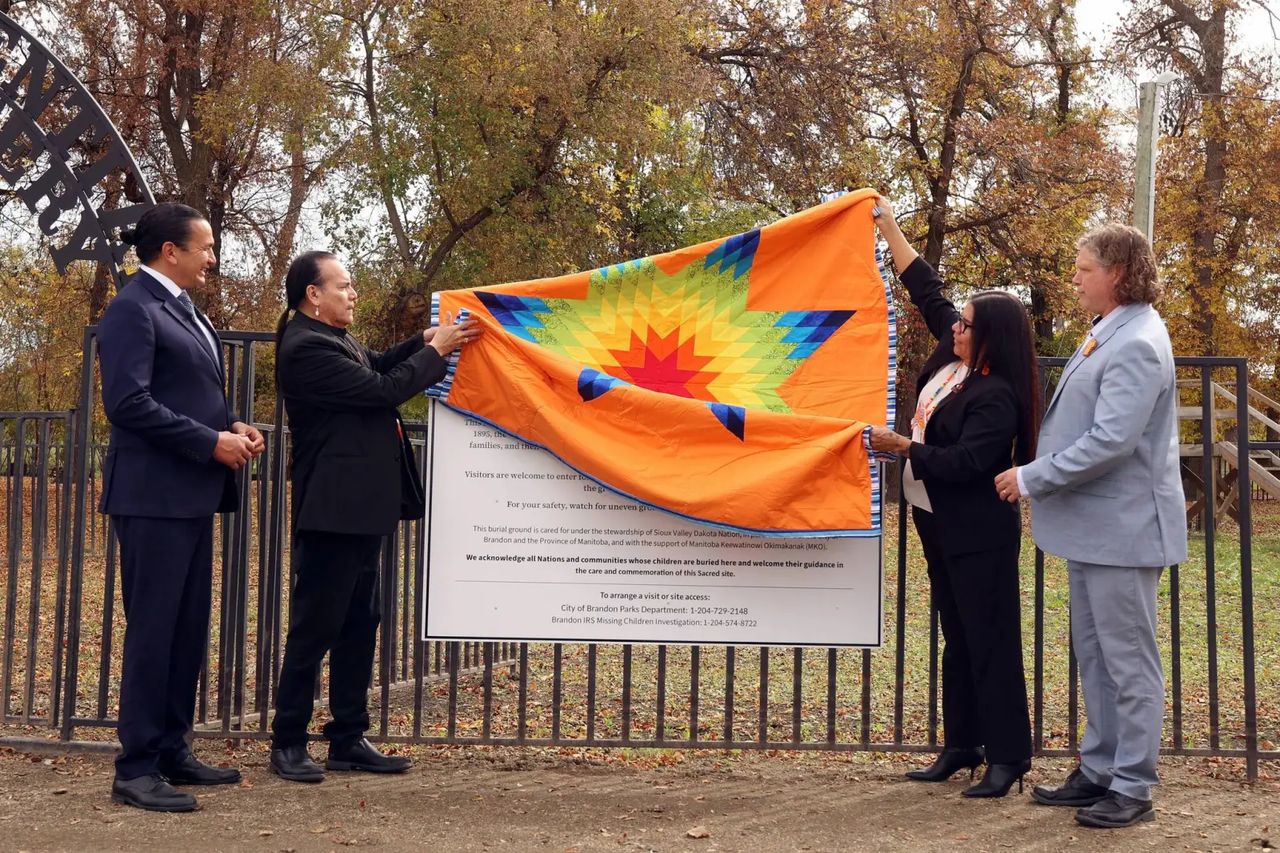
Manitoba and Brandon buy campground holding residential school graves
The province and city will spend $1.9 million to acquire the site, where future decisions will be guided by Sioux Valley Dakota Nation.
BRANDON — The Manitoba government and the City of Brandon have purchased a private campground that contains the graves of children who attended the former Brandon Indian Residential School.
The province contributed $1.5 million and the city $400,000 to buy the Turtle Crossing Campground property, the province said in a news release Tuesday.
"Today's a historical occasion, not only for Sioux Valley Dakota Nation, but Indigenous people across Canada as well as Manitoba," Sioux Valley Chief Jennifer Bone said at the site.
READ MORE: Manitoba premier opposes criminalizing residential school denialism
READ MORE: Ontario to move northwestern region to permanent daylight time
Premier Wab Kinew, who visited the site with Bone on Tuesday, said the purchase was necessary to preserve the truth.
"We need to preserve a site like this one, as well as a very well documented history of the deaths that took place in residential schools, and the records that show where these children are buried, because there could be no denying what took place," said Kinew.
He will dedicate a memorial at the site on Wednesday, Canada's National Day for Truth and Reconciliation, a provincial source said.
The province said Sioux Valley Dakota Nation "has stepped up as a steward of its traditional territory to help ensure the area is honoured, protected and cared for."
Future decisions about the site will be guided by survivors, affected First Nations and advocacy groups, the province said.
Historical records indicate a cemetery where children from the school were buried south of the school site, near the Assiniboine River, was used from 1895 to 1912.
"This land contains the buried remains of children who attended the Brandon Indian Residential School and their existence has been documented for more than 100 years," Kinew said.
Church records and provincial vital statistics files have documented the cemetery for generations, and it remains within living memory for many families, Kinew said in the release.
The area was converted into a suburban park before being sold and developed into the privately owned Turtle Crossing Campground in 2001.
An initial geographical survey in 2018 identified 56 potential gravesites at the campground, Chief Bone has said previously.
Manitoba Keewatinowi Okimakanak, an advocacy group involved in the site's future, says the site includes 56 children from eight of its communities.
A fence and memorial marker at the cemetery were removed in the mid-2000s, and Bone has said the graves have been repeatedly disturbed by developers since the 1920s.
In 2023, the First Nation and Manitoba Keewatinowi Okimakanak called on the province to designate the campground a provincial heritage site for better protection.
Sioux Valley Dakota Nation, which owns the land where the residential school once stood, has partnered with university researchers to identify all children who died at the school.
Christopher Mancuso, a Sioux Valley geophysical scientist leading the investigation, said access to the grounds is critical.
"This is monumental, because this has been in the making for 60 years. And it finally allows us the ability to conduct an investigation and to allow families to pay respects to those who died at the residential school," Mancuso said.
For Sioux Valley councillor Melissa Hotain, the purchase is a relief and a step toward reconciliation.
"To me, this is a step in reconciliation, in having access to the children, to honour them in a good way, to be able to commemorate the site and for families to actually have access and to visit," Hotain said.
She said there is still more work to secure the site and create a place where elders can come to honour the children.
The Brandon Residential School opened in 1895 and closed in 1972.
With files from CBC News, CityNews and APTN News