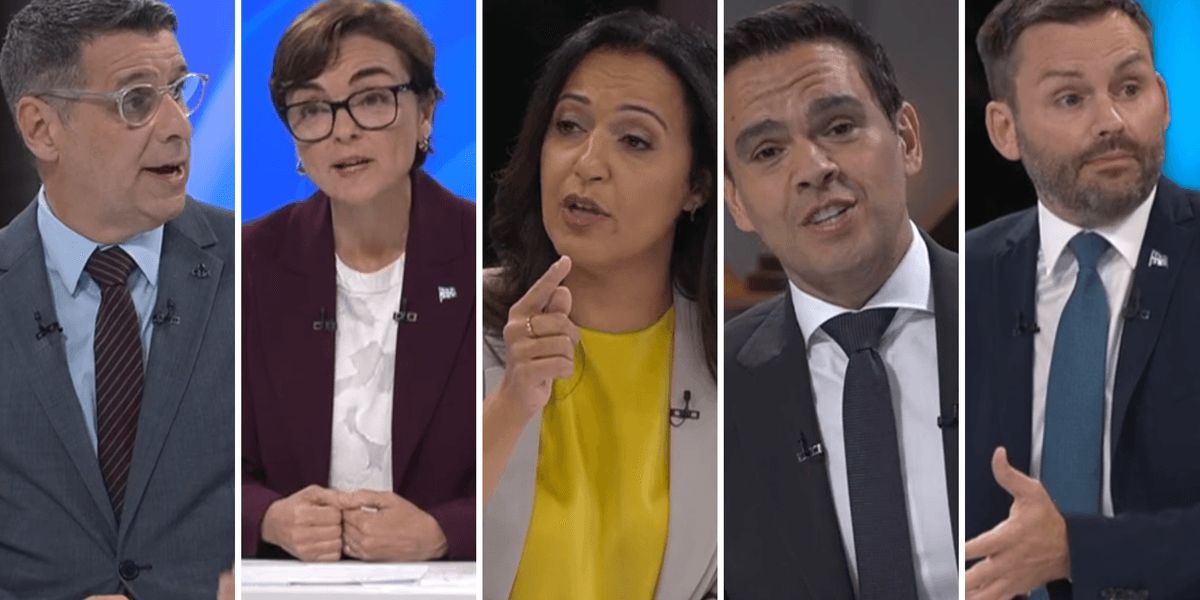
Quebec Leaders Clash Over Referendums, Infrastructure in Heated Second Election Debate
The five major party leaders faced off in a contentious second debate ahead of Quebec's 2026 election, featuring sharp exchanges on sovereignty, infrastructure spending, and youth policies, with the CAQ defending its record while opponents questioned its priorities.
The five principal party leaders competing to govern Quebec engaged in a markedly more confrontational second debate on September 16, revealing deepening divisions over Quebec's political future and practical governance challenges. Moderated by Michel Bherer, this Bell Media debate followed a more subdued first confrontation on TVA and preceded a final scheduled debate on Radio-Canada. The 90-minute event, structured around 20 targeted exchanges across five thematic blocks, provided crucial insight into party positions just weeks before Quebecers head to the polls on October 5.
Constitutional Debate Dominates Early Exchanges
CAQ leader Christine Fréchette opened with a carefully balanced admission about her party's tenure, stating
"In recent years, let's face it, the CAQ hasn't been perfect"while emphasizing lessons learned and corrections made. This partial acknowledgment of past missteps served as preamble to her central campaign theme of stability versus uncertainty. Her warning about the PQ's referendum plans -
"Is this really the time to add uncertainty with Paul St-Pierre Plamondon's referendum?"- strategically framed the constitutional question as disruptive to addressing Quebecers' pressing daily concerns.
PQ leader St-Pierre Plamondon countered by highlighting generational shifts, noting
"All those under 49 have never been questioned"about sovereignty, positioning the issue as unfinished democratic business rather than regression. When Liberal leader Charles Milliard cited 70% opposition to another referendum, the PQ leader's quick retort -
"80% of Quebecers don't want the Liberal Party either"- demonstrated his rhetorical agility in deflecting polling-based arguments against sovereignty discussions. This exchange revealed fundamental differences in how parties interpret Quebec's political evolution since the 1995 referendum.
Infrastructure Plan Becomes Litmus Test
The proposed third highway link between Quebec City and its south shore emerged as a surprising flashpoint, revealing ideological divides on infrastructure spending priorities. Québec Solidaire's Ruba Ghazal dismissed the CAQ's signature project with biting humor:
"Every election campaign, the CAQ discovers its passion for the 3rd link and then there's a breakup. And now it's starting again."Her characterization of the project as cyclical political theater rather than serious policy drew laughter while isolating Fréchette on stage.
The CAQ leader's defense that this wasn't
"some foolish idea"and PSPP's nuanced position - opposing the CAQ's specific
"scrap of paper"plan while leaving room for alternative proposals - showed leaders carefully calibrating positions on this symbolically charged issue. The infrastructure debate unexpectedly became a proxy for broader questions about government planning and fiscal responsibility.
Economic Record Under Microscope
Liberal leader Milliard sustained sharp attacks on CAQ economic management, using vivid retail metaphors:
"It's like you're shopping at Costco. They come in packs of six."His persistence in redirecting Fréchette -
"Right now you're debating me"- when she pivoted to sovereignty arguments revealed Liberal strategy to anchor debate in governance critiques rather than constitutional questions. This tactical maneuvering underscored Milliard's effort to position the Liberals as the party of economic competence.
This exchange proved particularly revealing, with the CAQ attempting to shift discussion to its preferred terrain of stability versus PQ constitutional plans, while the Liberals insisted on examining the government's concrete economic performance. The dynamic illustrated competing campaign narratives vying for voter attention in the campaign's final weeks.
Youth Policy and Social Media Regulation
The segment on Quebec youth's future produced unexpected convergences between typically opposed leaders. Milliard and St-Pierre Plamondon found common ground on regulating youth social media use, suggesting potential bipartisan support for measures addressing technology's impact on young Quebecers. However, their temporary alliance fractured when Milliard linked referendum debates to youth anxiety, prompting the PQ leader to assert that sovereignty constituted
"a separate issue from youth anxiety".
This exchange revealed continuing efforts by the PQ to keep constitutional questions alive in public discourse despite majority opposition, while other parties sought to connect such debates to contemporary social concerns. The youth policy discussion also highlighted generational divides in how political priorities are framed.
Immigration Debate Reveals Philosophical Rifts
The final segment exposed profound differences in approaching immigration and social services allocation. Conservative leader Éric Duhaime's argument for prioritizing
"Quebec taxpayers"over asylum seekers in allocating services like daycare spots drew Milliard's accusation of
"political sugar-coating"regarding immigrants. Their exchange grew particularly heated when Duhaime proposed a lottery system for daycare placements, prompting Milliard's dismissive gesture and remark:
"Exaggeration isn't really my thing."
Milliard's warning that Conservative childcare policies would disproportionately affect women by reducing availability highlighted how social policy debates increasingly intersect with gender equality considerations in Quebec politics. This clash underscored fundamentally different visions for Quebec's social contract and the role of government in service provision.
Strategic Implications Moving Forward
With the final Radio-Canada debate scheduled for September 23, this confrontation revealed evolving campaign dynamics. The CAQ's persistent efforts to constitutionalize the election battle versus opposition parties' focus on governance records suggests competing theories of voter motivation. While polls show referendum opposition, the PQ's success in keeping sovereignty discussions alive indicates this historic cleavage still resonates with portions of the electorate.
The debate also showcased leaders refining their rhetorical approaches - from Fréchette's disciplined messaging about stability to PSPP's nimble constitutional arguments and Milliard's economic-focused attacks. As advance voting approaches on September 30, these performances may prove decisive in a race where policy differences have crystallized but voter intentions remain fluid.
Debate Format and What Comes Next
Modeled after Noovo's Les débatteurs program, this debate's structured format featuring 20 specific confrontations allowed for more targeted policy comparisons than traditional free-flowing debates. The five thematic blocks - cost of living, economic infrastructure, youth prospects, healthcare with homelessness, and language/immigration policies - provided comprehensive coverage of key election issues.
The September 23 Radio-Canada debate, moderated by veteran journalist Patrice Roy, represents the last high-profile opportunity for leaders to redefine campaign narratives before advance voting begins. With the campaign entering its decisive phase, Quebec voters now have clearer contrasts to evaluate before casting their ballots on October 5. The final debate will likely see intensified efforts from all parties to consolidate support and motivate their bases in this competitive multi-party race.