Gambler's fallacy
The gambler's fallacy is a cognitive bias in probability reasoning where an individual mistakenly believes that a past sequence of independent, random events influences the likelihood of future outcomes. Also known as the Monte Carlo fallacy, it is most commonly observed in gambling contexts, such as believing a roulette wheel is 'due' for a red result after a long streak of black. This fallacy is a critical concept to understand, as it can lead to significant financial losses in casino games, poker, and sports betting, and can also distort decision-making in fields like finance and law. It has been included in psychological research and is frequently illustrated in popular examples from games of pure chance.
Definition and Core Mechanism
The gambler's fallacy is defined as the erroneous belief that if a particular random event has occurred more or less frequently than its expected probability over a series of trials, future trials are more likely to produce the opposite outcome to 'correct' the imbalance. This belief hinges on a misunderstanding of statistical independence, where the outcome of one trial has no causal or probabilistic connection to the outcome of another. For instance, the probability of a fair coin landing on heads is precisely 1/2 for every single toss, regardless of whether the previous ten tosses were all heads. The fallacy arises from the intuition that a streak must eventually 'even out' to be representative of the long-term average, a notion often described as a belief in the 'law of small numbers'. This leads individuals to perceive patterns and predictability in sequences that are, by definition, random and memoryless. The term is also called the fallacy of the maturity of chances, reflecting the flawed idea that chances somehow mature or become ripe for a change after a run of similar results.
Historical and Famous Examples
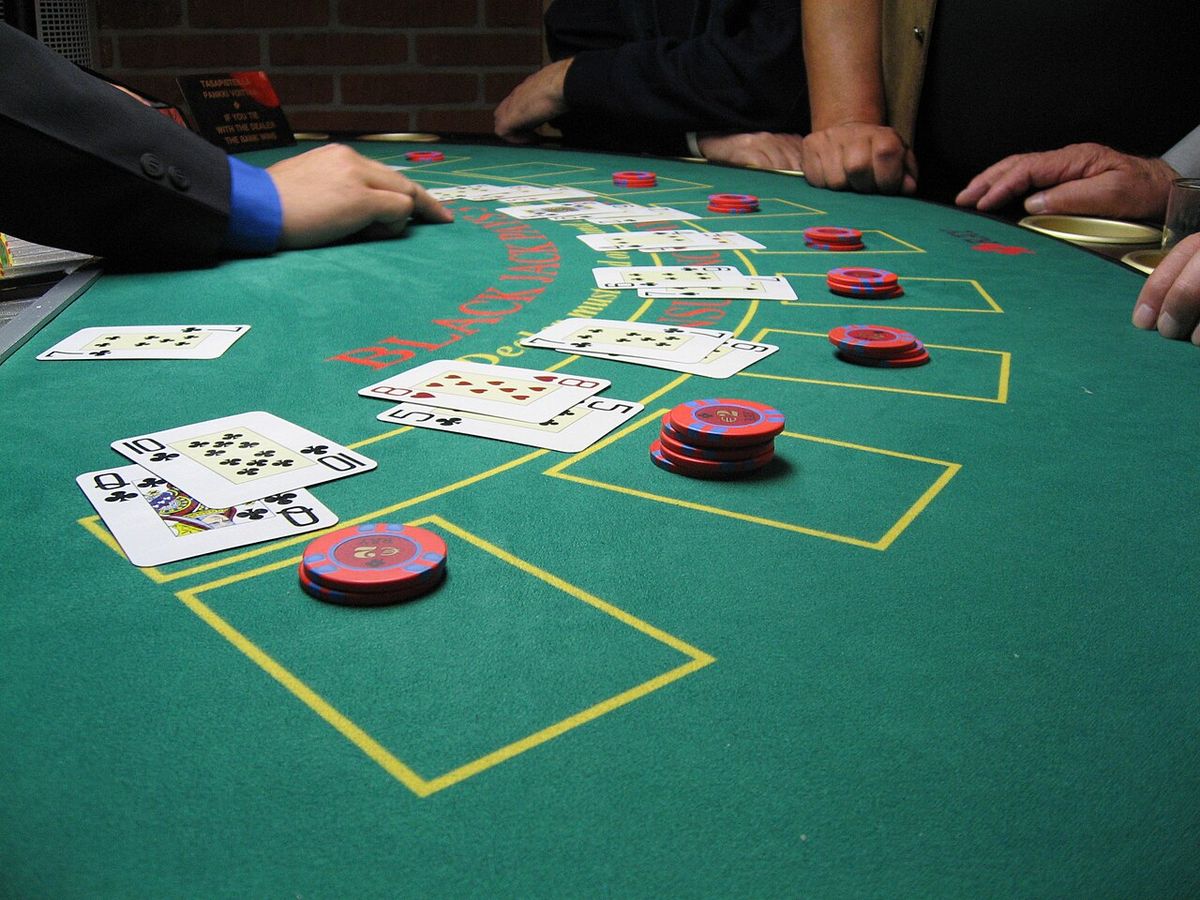
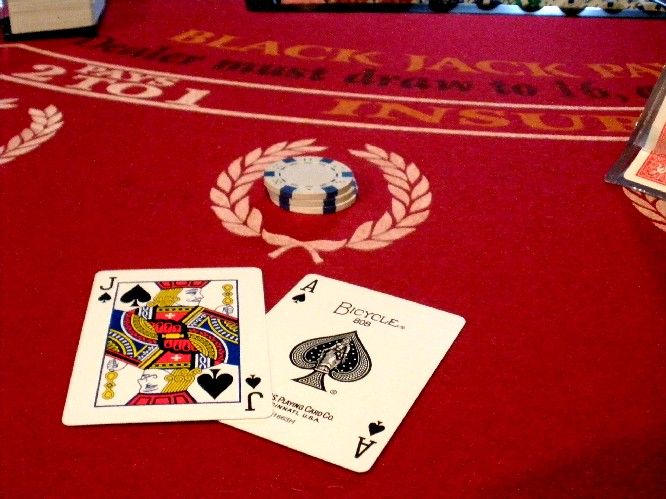
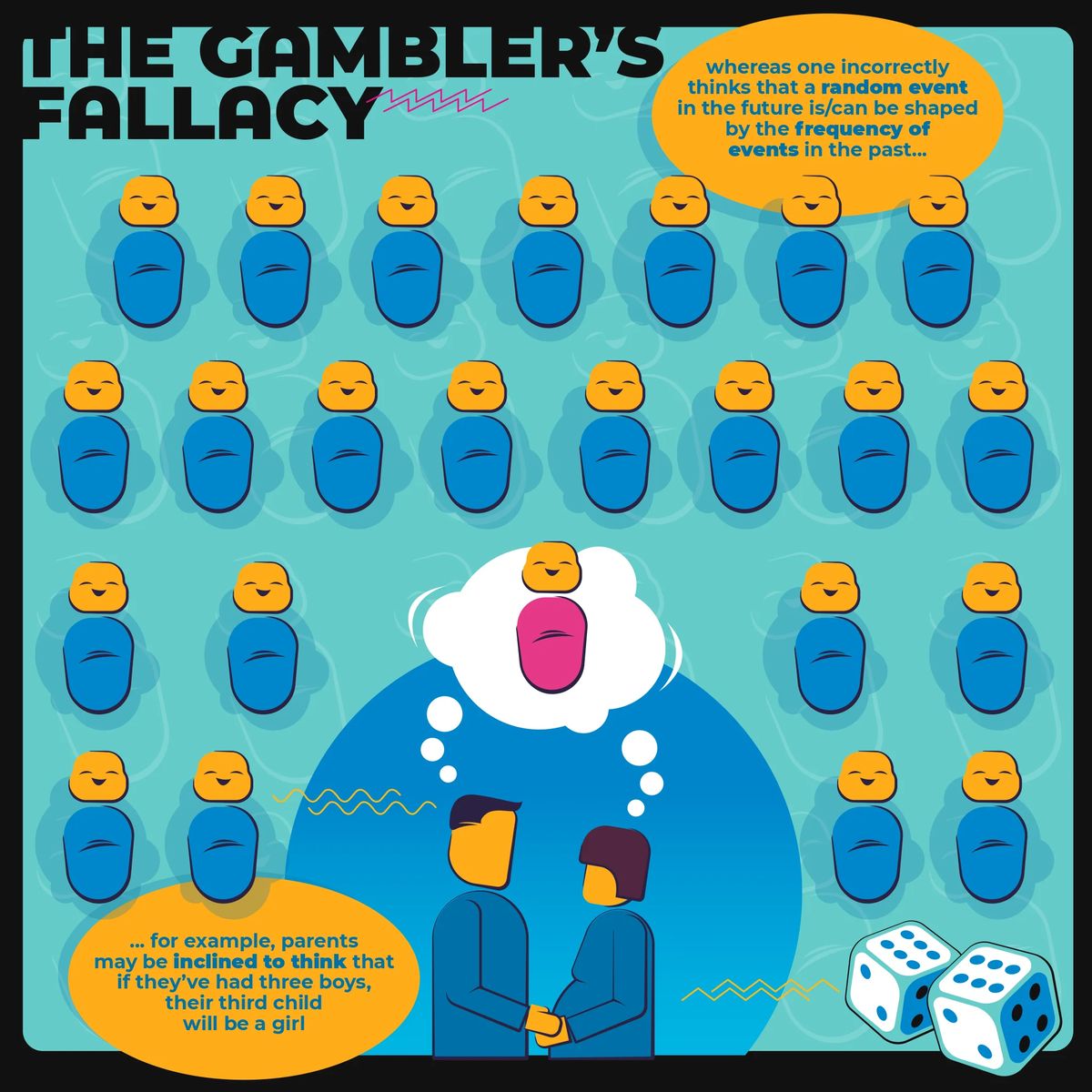
The most famous historical instance of the gambler's fallacy occurred on August 18, 1913, at the Monte Carlo Casino. During a game of roulette, the ball landed on black 26 consecutive times, an extraordinarily rare event with a probability of approximately 1 in 68.4 million for a single-zero wheel. As the streak progressed, gamblers increasingly bet on red, incorrectly reasoning that the wheel was due for a red outcome to balance the sequence. This incident led to massive financial losses and cemented the association of the fallacy with the casino's name. Centuries earlier, in 1796, mathematician Pierre-Simon Laplace described a similar fallacy in his essay on probabilities, noting expectant fathers who feared that a high number of boy births in their community would make them more likely to have a daughter. A modern hypothetical example involves a blackjack player who believes a five-day losing streak guarantees a win on the fifth day, leading to further losses when the independent probabilities do not align with her perceived pattern.
Psychological Origins and the Representativeness Heuristic
Psychologists Amos Tversky and Daniel Kahneman identified the gambler's fallacy as a product of a mental shortcut called the representativeness heuristic. This heuristic leads people to judge the probability of an event by how closely it resembles their mental model of a typical random process. People expect that short sequences of random outcomes, like coin flips, should mirror the properties of a much longer sequence, specifically that deviations from the average will quickly balance out. After observing several red outcomes on a roulette wheel, a person using this heuristic believes a black result would make the overall sequence look more 'representative' of a 50/50 distribution than another red. This is coupled with an insensitivity to sample size, where people underestimate how common streaks can be in small samples. Other contributing factors include a belief in a just world where chance processes are fair and self-correcting, and in some cases, an internal locus of control where gamblers believe their own skill or destiny can override pure randomness. Researchers also link the fallacy to the clustering illusion, where people perceive streaks in small samples as evidence of a non-random process when they are actually common in random data.
Mathematical Illustrations and Key Calculations
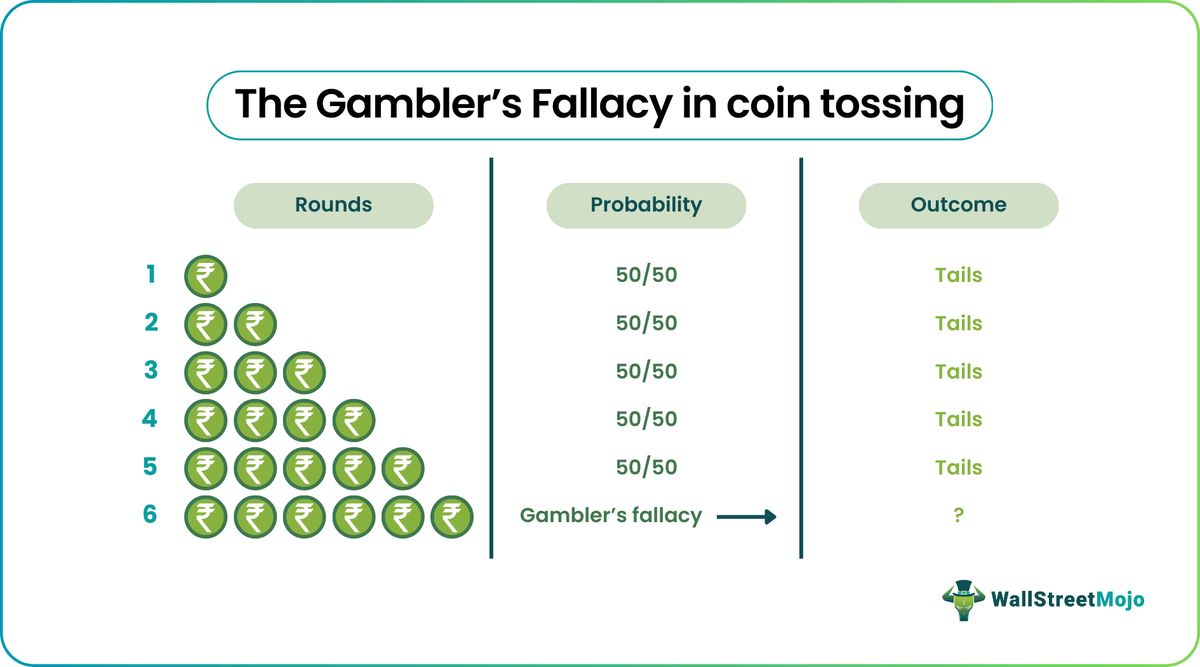
A clear mathematical illustration uses a series of fair coin tosses. The probability of flipping five heads in a row is (1/2)^5, or 1 in 32. However, after four heads have already been flipped, the probability the next flip is heads remains 1/2, as each flip is independent. The completed sequence of five heads is no more or less likely than the specific sequence of four heads followed by one tail. The fallacy is the mistaken belief that the past four flips somehow alter the odds of the fifth. For a fair coin flipped 21 times, the probability of 21 heads is 1 in 2,097,152, but after 20 heads, the next flip's probability is still 1/2. For a fair 16-sided die, the probability of rolling a 1 is always 1/16 (6.25%). The probability of getting at least one win in 16 rolls is about 64.39%. After one loss, with 15 rolls remaining, the probability of at least one win drops to about 62.02%, demonstrating that probability of success decreases with fewer trials, not increases after losses. These calculations definitively show that past independent trials do not change future odds.
- The probability of 20 heads then 1 tail is exactly equal to the probability of 21 heads: both are 0.5^21.
- In a sequence of 21 coin flips, every unique combination of heads and tails has the same probability: 1 in 2,097,152.
- Bayes' theorem, when applied to a known fair process, confirms the probability of the next outcome is the same as the base rate (e.g., 1/2 for a fair coin).
Variations and Related Cognitive Biases
Beyond the classic form, researchers have identified several variations of the gambler's fallacy. The inverse gambler's fallacy, described by philosopher Ian Hacking, occurs when someone observes a rare event and erroneously concludes it must have been preceded by many trials. For example, walking into a room to see someone roll double sixes with dice and assuming they have been rolling for a long time. The retrospective gambler's fallacy involves making inferences about unknown past events based on known subsequent events, such as seeing multiple heads in a row and concluding the previous unknown flip was likely tails. Some researchers categorize two types the classic 'type one', which assumes conditions are fair and a reversal is due, and 'type two', where a gambler underestimates the sample size needed to detect a real bias in a game. Another related bias is the hot-hand fallacy, where people believe a person experiencing success in a random or skill-based task has a heightened probability of continued success, though empirical evidence in truly random casino games often shows the gambler's fallacy is more prevalent. Studies involving Stanford University students have concluded that the retrospective gambler's fallacy is a real phenomenon, with implications for how we perceive both past and future events.
Non-Examples and Exceptions to the Fallacy
The gambler's fallacy strictly applies to independent events. It does not apply in scenarios where probabilities are not independent, such as drawing cards from a deck without replacement. In blackjack, if an ace is removed from the deck, the probability of drawing another ace decreases from 4/52 (7.69%) to 3/51 (5.88%), while the probability for each other rank increases slightly. This changing probability is the basis for legal card counting strategies. Another exception occurs when there is legitimate evidence of bias. If a coin shows 21 heads in a row, Bayesian inference suggests the coin may be biased towards heads, and betting on heads becomes a rational conclusion, not a fallacy. Similarly, if external game rules change to favour one player, the probabilities change accordingly. These are not examples of the fallacy because the underlying assumptions of fairness and independence are violated.
- Drawing cards from a finite deck without replacement (e.g., blackjack, poker).
- When a mechanical device shows consistent evidence of bias (e.g., a weighted die).
- When game rules or conditions are altered mid-sequence.
- In games of skill where past performance may inform future potential (though this is distinct from pure chance).
- Statistical processes where events are explicitly linked or dependent.
Impact Beyond Gambling in Professional Judgement
The gambler's fallacy has significant implications far beyond the casino floor, affecting professional judgment and institutional decision-making. When individuals in positions of authority fail to recognize the statistical independence of sequential cases, they may 'autocorrect' their decisions based on perceived streaks. Research by Daniel Chen, Tobias Moskowitz, and Kelly Shue found that judges, loan officers, and asylum officials can make erroneous decisions, with error rates up to 5 percent in some studies, by rejecting an application after a streak of approvals simply because they believe such a streak is unlikely to continue. This occurs even when cases are presented in a random order, as the quality of one application is independent of the next. In finance, an investor might overestimate the probability of a successful investment based on a past winning streak, neglecting a thorough analysis of the asset's true value. In science, a researcher might mistakenly see a pattern in random particle movements and formulate an incorrect law. These examples demonstrate how the fallacy can lead to suboptimal outcomes by creating false causal narratives for unrelated events. The fallacy can even influence public policy, such as if a government blamed a market crash on an unrelated immigration program based on a coincidental sequence of events.
Prevalence in Gambling and Canadian Context
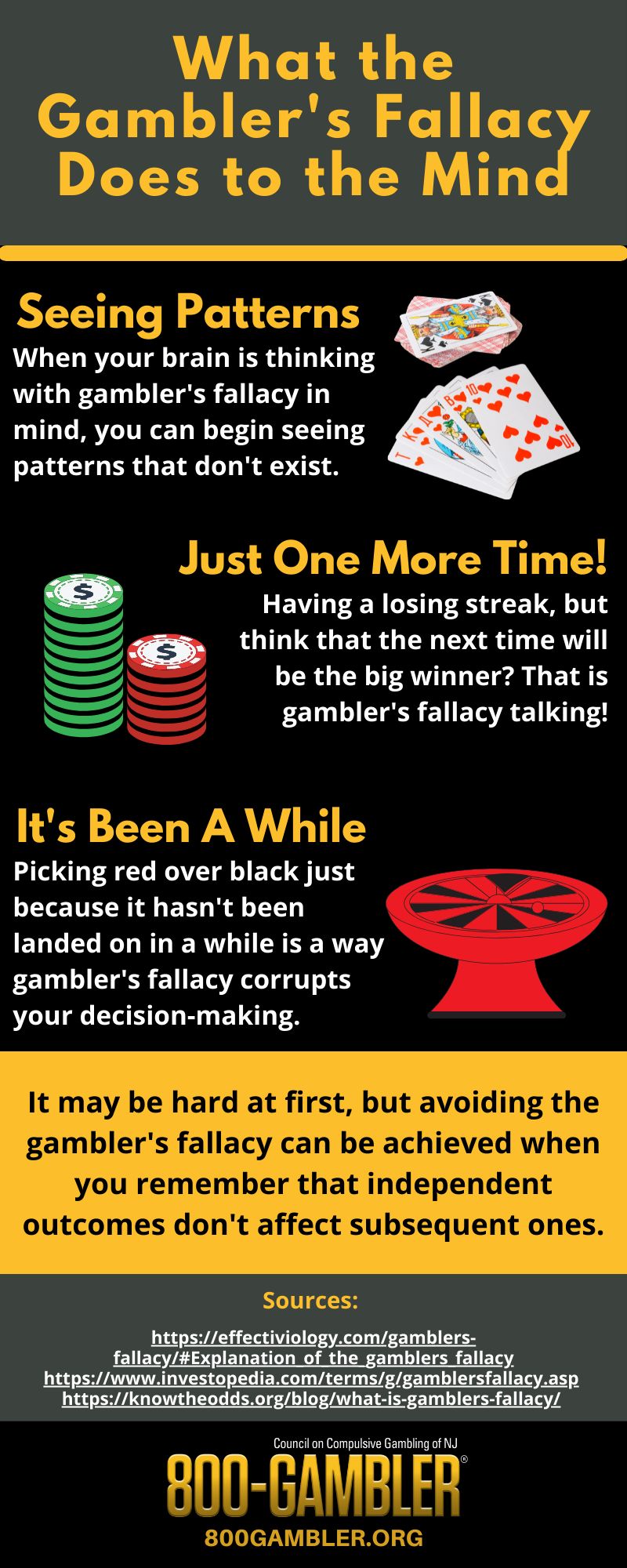
The gambler's fallacy is a universal cognitive bias, but it holds particular relevance in regulated gambling environments like those across Canada. In provincial casinos and online gaming sites where games like roulette, slots, and craps are offered, each spin, deal, or roll is designed to be an independent event. Canadian players, like gamblers everywhere, may fall prey to the fallacy, for instance, by believing a slot machine is 'due' for a jackpot after a long dry spell or that a certain dice number is more likely after not appearing for several throws. Understanding this fallacy is a key component of responsible gambling education promoted by provincial organizations. It frames the importance of recognizing that in games of pure chance, no strategy based on past outcomes can predict future results. This knowledge is crucial for adults engaging in gambling, as it helps frame the activity as entertainment with a built-in statistical disadvantage, rather than as a system that can be beaten through pattern recognition. The fallacy also appears in sports betting, where bettors may believe a team is due for a win after a losing streak, ignoring independent factors for each game.
| Game Example | Independent Event | Fallacious Belief | True Probability Remains |
|---|---|---|---|
| Slot Machine Pull | Each press of the button | Machine is 'hot' or 'cold' | Determined by RNG, fixed per spin |
| Dice Roll (Craps) | Each throw of the dice | A specific number is more likely after an absence | 1/6 for any specific number |
| Lottery Draw | Each weekly draw | Numbers from last week are less likely this week | Identical for all combinations each draw |
| Coin Toss | Each flip | Tails after a run of heads | 1/2 for heads or tails |
Questions about Gambler's fallacy
What is a simple example of the gambler's fallacy?
A classic example is coin tossing. If a fair coin lands on heads five times in a row, the gambler's fallacy is the belief that the sixth toss is more likely to be tails to 'balance out' the streak. In reality, each toss is independent, and the probability remains 50/50 for heads or tails on every single flip, regardless of past results. This misconception applies to any game of chance with independent trials, such as roulette spins or dice rolls. The mathematical probability of the sixth head is still 1/2, identical to the first flip.
Why is it called the Monte Carlo fallacy?
The name originates from a notorious event at the Monte Carlo Casino on August 18, 1913. During a roulette game, the ball landed on black 26 consecutive times, an extremely rare sequence. Gamblers lost millions betting on red, incorrectly believing that the streak made red more likely on subsequent spins. This high-profile incident cemented the association between the fallacy and the casino, leading to the alternative name 'Monte Carlo fallacy'. The probability of such a streak on a fair, single-zero wheel is about 1 in 68.4 million.
Does the gambler's fallacy mean a streak can never happen?
No, the gambler's fallacy does not state that streaks are impossible. In fact, streaks are a natural part of random sequences. The fallacy is in believing that the occurrence of a streak changes the underlying probability of future events. For a fair coin, a run of ten heads is very unlikely in advance, but if nine heads have already occurred, the chance of a tenth head is still 1/2. The odds do not adjust to compensate for past results. Streaks feel unusual but are mathematically expected in long sequences of random trials.
How is the gambler's fallacy different from card counting in blackjack?
The gambler's fallacy applies only to independent events, like roulette spins or coin flips, where probabilities are constant. Blackjack, when played with a finite deck and no replacement, involves dependent events. As cards are dealt, the composition of the remaining deck changes, which legitimately alters the odds of drawing certain cards. Card counting tracks these changing probabilities, making it a valid strategic approach, not an example of the fallacy. In blackjack, the probability of drawing an ace decreases as aces are removed, a real change the fallacy does not account for.
Can the gambler's fallacy affect decisions outside of gambling?
Yes, research shows the gambler's fallacy can distort professional judgment. Studies have found that judges, loan officers, and sports referees may make a decision contrary to a recent streak of similar decisions because they mistakenly believe a streak is statistically unlikely to continue. For example, a loan officer might deny a strong application after approving several in a row, even though each case should be evaluated independently on its own merits. This autocorrection can lead to error rates as high as five percent in some decision-making sequences, impacting fairness and outcomes.
What is the opposite of the gambler's fallacy?
A related but distinct bias is the hot-hand fallacy, where people believe a person on a successful streak is more likely to continue succeeding. While the gambler's fallacy predicts a reversal after a streak, the hot-hand fallacy predicts continuation. In games of pure chance like casino games, the hot-hand belief is usually incorrect, though in skill-based activities like basketball, debate continues about whether a 'hot hand' is a real phenomenon. Another opposite concept is the inverse gambler's fallacy, which involves incorrectly inferring a long past sequence from a single rare present event.
Sources and further reading
- Gambler's fallacy (Wikipedia)
- Why do we think a random event is more or less likely to occur if it happened ... (thedecisionlab.com)
Checked by the Nosy Mag desk. Last updated 2026-11-10.