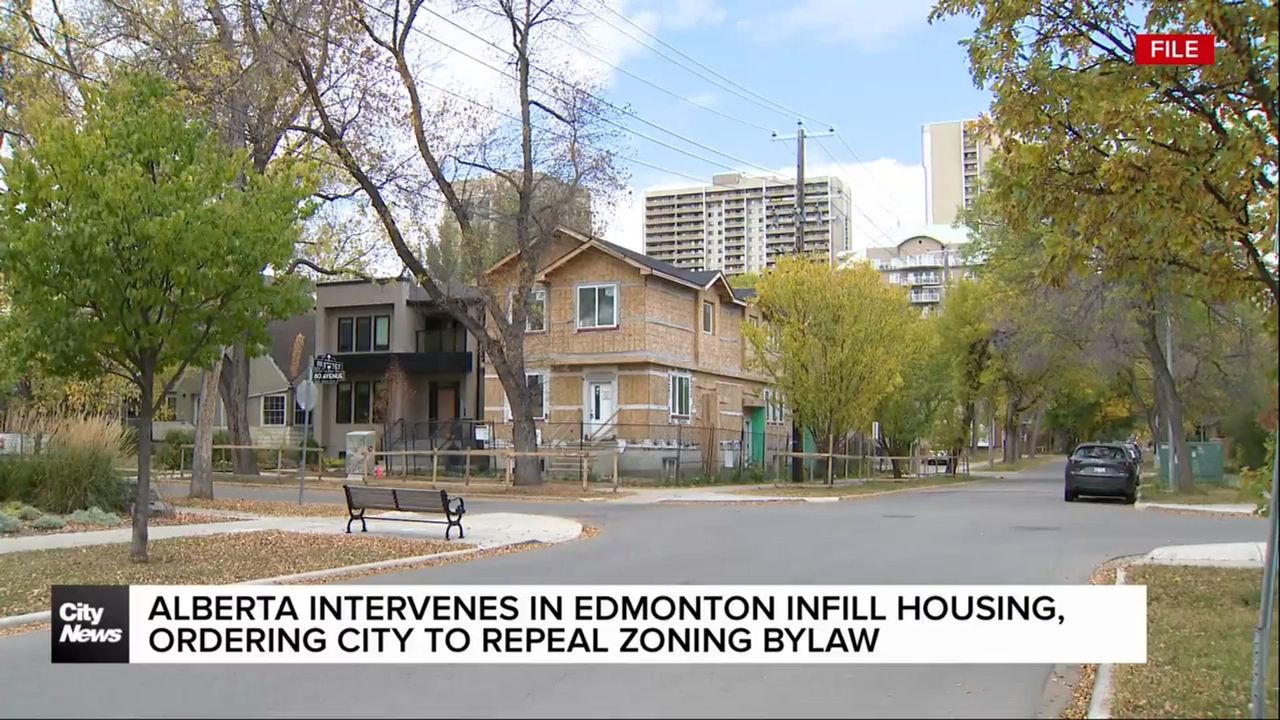
Alberta orders Edmonton to repeal zoning bylaw, restrict infill development
The province is also directing Calgary to maintain its pre-2024 bylaw framework as part of interim measures.
EDMONTON — The Alberta government has ordered the City of Edmonton to repeal its zoning bylaw and restrict the growth of infill development.
Premier Danielle Smith, speaking at a news conference Thursday, said the province is directing the city to revert to zoning parameters that were in place before 2024 and restore minimum on-site parking requirements that existed before 2020.
"While Edmonton has taken some steps to amend portions of its bylaws and lessen the impact in established neighborhoods, the overall approach to infill remains in place," Smith said.
READ MORE: Edmonton infill debate escalates as residents, developers clash over zoning changes
READ MORE: Alberta to seek private proposals for Calgary-Edmonton high-speed rail
Edmonton will have three months to amend its bylaw and 18 months to comprehensively review its land-use rules to develop a "more balanced" approach, she said.
The province is also requiring the City of Calgary to maintain its current pre-2024 bylaw framework, which Smith said means "returning to reasonable density and height rules, common sense minimum parking requirements and considerations for utilities and water infrastructure requirements."
Calgary, which recently repealed blanket rezoning, will be directed to create an overlay identifying lands restored to previous low-density residential zones.
Municipal Affairs Minister Dan Williams said it is unusual for the province to intervene on municipal development bylaws, but necessary to ensure new housing balances Albertans’ goal of home ownership in safe, affordable and livable communities.
"This announcement is about restoring the possibility for Alberta to grow in a thoughtful and balanced way. It's about giving Albertans a voice before their neighborhoods are permanently changed," he said.
Edmonton Mayor Andrew Knack decried the announcement, calling the province's "uninformed directive" one that will make the city less affordable, drive up property taxes and create months of uncertainty.
"I am not entirely convinced the premier knows what she is doing, or what the consequences will be. What the premier is flirting with would cause tremendous chaos," Knack said.
He said the city is growing rapidly and each new suburb requires expensive infrastructure, the cost of which is passed on to taxpayers.
Knack said he was considering options on how to fight the order but conceded that if he and members of council do not follow it they could be removed from office.
In 2024, Smith's government gave itself the power to rescind municipal bylaws deemed to be at odds with provincial policies and to call a vote on whether a local elected official should be removed.
Williams said the province was not issuing an ultimatum but launching a "conversation." Knack pushed back, saying "a conversation after a decision has been made is not a conversation at all."
Critics of Edmonton's zoning bylaw, who have been protesting its effects, cheered the announcement.
Jaclyn Soroka, a co-founder of Edmonton Neighbourhoods United, thanked the government for listening to residents' concerns. "This is about thoughtful city planning; something that affects every Edmontonian regardless of their political beliefs," Soroka said.
Jacob Dawang, an advocate with Grow Together Edmonton, which favoured the changes, said the province's announcement amounts to a war on housing affordability in Alberta's capital city.
Damian Collins, a housing scholar and University of Alberta professor, said undoing the zoning bylaw will create a lot of uncertainty, with investment decisions made based on the current rules now in question.
"Even if you don't like eight-plexes that much, the zoning bylaw deals with a lot more than just that specific housing type," Collins said.
Dylan Bressey, president of Alberta Municipalities, said the province's interference offends voters who just a year ago went to the polls across the province to elect new mayors and councils.
"Municipal leaders across the province are saying enough is enough," said Bressey, a councillor in Grande Prairie.
Opposition NDP Leader Naheed Nenshi said Smith was straying out of her legislative lane. "This is a municipal responsibility, full stop," he said.
Smith, asked about the civic election where voters elected a mayor and council that largely reflected support for the existing policy, said voters vote for many reasons and the province has a higher obligation.
"When municipalities have taken actions that are undermining people's property value, when you see the kind of reaction that we've seen from residents, then we have to step in," she said.
Nosy Mag reported in September that growing tensions over Edmonton's infill development policies had prompted residents to take legal action and even buy neighboring properties to block multi-unit projects.
With files from The Canadian Press, CBC News and Global News