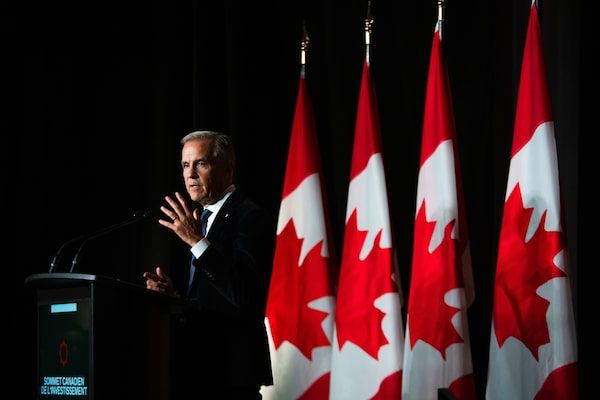
Carney's Investment Summit Draws Global Interest and Protests in Toronto
Prime Minister Mark Carney touts Canada's economic potential at Toronto investment summit amid planned protests from civil society groups.
Hundreds of global investors and business executives from across the world arrived in Toronto this week for Canada's inaugural investment summit, a high-stakes gathering that Prime Minister Mark Carney framed as a transformative moment for the nation's economy. The event, held at the prestigious Royal Ontario Museum, brought together political leaders and corporate decision-makers to showcase Canada's economic potential, while simultaneously drawing organized opposition from civil society groups concerned about corporate influence over public policy.
The Summit's Strategic Vision
Prime Minister Carney opened the summit with a compelling vision of Canada's economic future, emphasizing the country's unique combination of natural resources, human capital, and technological innovation. Speaking to an audience that included Canadian business leaders and politicians, Carney articulated a bold national agenda.
"We have what the world wants: the energy, the resources, the talent, the technology and the capital,"he declared, positioning Canada as a prime destination for global investment.
The Prime Minister's remarks carried particular weight given his background as former Governor of the Bank of Canada and Bank of England. His reference to trust as Canada's greatest strength,
"something that cannot be found on any balance sheet,"was widely interpreted as a pointed contrast with the economic policies and political climate in the United States under former President Donald Trump. This emphasis on stability and reliability forms the foundation of Carney's ambitious plan to attract $1 trillion in investment over the next five years.
Ontario's Investment Portfolio
Ontario Premier Doug Ford played a prominent role in the summit, showcasing the province's economic assets to international investors. Ford's office confirmed attendance by delegates from eight countries spanning four continents: Kuwait, Malaysia, the Netherlands, Singapore, Qatar, Norway, Japan and Australia. The Premier emphasized Ontario's competitive advantages, stating
"We are building an economy that can compete with anyone, anywhere."
Ford highlighted 15 major provincial projects across strategic sectors including energy production and transmission infrastructure, critical minerals extraction and processing, artificial intelligence development, and advanced manufacturing capabilities. These projects represent key components of Ontario's industrial strategy and align with broader national priorities in technology and resource development. The Premier's assertive message
"Ontario has what the world needs and we're going to make sure the world knows it"underscored the province's ambition to position itself as a global investment hub.
Political Consensus and Corporate Participation
The summit achieved notable political alignment across traditional partisan lines. A confidential source revealed that former Conservative Prime Minister Stephen Harper would deliver closing remarks, demonstrating cross-party support for the investment initiative. This political unity reflects the summit's focus on economic growth as a national priority transcending political differences.
Corporate participation included influential figures such as Cohere CEO Aidan Gomez, representing Canada's burgeoning artificial intelligence sector, and Sara Wilshaw, Canada's chief trade commissioner. Their presence signaled strong private sector engagement with the government's economic agenda. Carney framed this collaboration as evidence of a
"new consensus from Iqaluit to Victoria to Quebec City and St. Johns"about Canada's economic direction, suggesting broad alignment on increasing domestic production, expanding international trade relationships, and pursuing sustainable economic growth.
Civil Society Opposition
While business and political leaders convened inside the Royal Ontario Museum, outside its walls a coalition of labor unions, Indigenous leaders, and climate activists prepared demonstrations under the banner "The Many vs. The Money." These groups announced plans for direct engagement with summit attendees, expressing deep skepticism about the summit's corporate-driven approach to economic development.
Protest organizers articulated specific concerns about three areas: potential privatization of public services, expansion of fossil fuel infrastructure including pipelines, and increased involvement in arms manufacturing. Their mobilization reflects growing public unease about economic strategies that prioritize large-scale private investment without sufficient consideration of social equity and environmental sustainability. The protesters' planned interventions aimed to challenge what they view as an undemocratic concentration of economic decision-making power in corporate hands.
Global Economic Context
The Toronto summit occurs against a backdrop of significant shifts in global economic relationships and supply chain dynamics. As countries worldwide reassess their trade dependencies and industrial strategies, Canada is positioning itself as a stable, rules-based alternative to more volatile markets. The focus on critical minerals and advanced manufacturing directly responds to international competition for leadership in high-tech and green industrial sectors.
While Prime Minister Carney hinted at several already-signed deals, specific details about investment commitments remained undisclosed at the summit's opening. This lack of transparency has been a point of concern for critics who argue that public accountability should accompany large-scale economic initiatives. The coming months will reveal whether the summit's promises translate into concrete projects that benefit broader Canadian society or primarily serve corporate interests.
Balancing Growth and Responsibility
The Toronto investment summit represents a defining moment for Carney's economic vision, testing whether Canada can attract substantial foreign investment while maintaining commitments to social welfare and environmental protection. The simultaneous enthusiasm from global investors and resistance from civil society groups highlights fundamental tensions in contemporary economic policymaking.
As the summit proceeds, the challenge for Canadian leaders will be to demonstrate that their investment strategy creates inclusive growth rather than exacerbating inequality. The event's long-term significance may depend on its ability to address criticisms about corporate concentration and sustainability while delivering tangible economic benefits across Canadian regions and sectors. With global capital and local activism converging in Toronto, the summit has become a focal point for debates about whose interests should shape Canada's economic future.
The Path Forward
The outcomes of this inaugural investment summit will likely influence Canada's economic trajectory for years to come. Success would be measured not just by the volume of investments secured, but by their distribution across sectors and regions, their contribution to employment and innovation, and their alignment with climate commitments. The protests outside the summit serve as a reminder that economic strategies must address broader societal concerns to achieve lasting legitimacy.
As Canada seeks to redefine its role in the global economy, the tensions on display in Toronto between capital and community, between growth and sustainability, will require careful navigation. The summit marks not an endpoint but the beginning of an ongoing conversation about what kind of economy Canada wants to build, and who should benefit from its development. The choices made in the wake of this gathering will shape the nation's economic identity for a generation.