Scratchcard
A scratchcard, also known as a scratch ticket or scratch-off, is a form of instant lottery game where players reveal concealed information by scratching off an opaque latex covering. In Canada, these games are operated by provincial lottery corporations such as the Ontario Lottery and Gaming Corporation (OLG), Loto-Québec, and the British Columbia Lottery Corporation (BCLC), and are sold at thousands of retail locations including corner stores and gas stations. Scratchcards are popular due to their low cost, instant results, and the potential for significant prizes. The games are a regulated form of gambling intended for adults, with all profits from provincial lottery tickets remaining within their respective regions to support community programs and government revenues.
Technology, manufacture, and evolution
The fundamental technology of a scratchcard involves printing hidden information, such as numbers, symbols, or a barcode, on a paper-based or plastic card and then covering it with an opaque, scratchable substance. This coating is resistant to normal abrasion but can be scratched off easily by a coin or fingernail. The original cards used an environmentally unsafe solvent-based coating. In the late 1980s, adhesive specialist Jerome Greenfield invented a safe water-based coating still used today.
To identify winning tickets and prevent fraud, a printed barcode is also included on the card and concealed under the same opaque ink, which retailers scan to validate prizes. The two major global manufacturers of these lottery tickets are Scientific Games Corporation, founded by scientist John Koza and retail promotions specialist Daniel Bower, and Pollard Banknote. Scientific Games has production facilities in the US, Chile, UK, Germany, Canada, Brazil and Australia, while Pollard Banknote has facilities in the US and Canada. Other manufacturing technologies include scratch labels, hot stamp foil, or 'sandwich' labels, which are easier for some producers to apply but can be more prone to sophisticated fraudulent manipulation compared to silkscreen latex panels that bond directly with the card body.
The evolution of scratchcard games has been driven by technological advances in randomization and printing. The first computer-generated instant lottery game was produced in 1974 by Scientific Games Corporation, moving away from manual randomization techniques. In 1987, Astro-Med, Inc. of West Warwick, Rhode Island, received the U.S. Patent for the instant scratch-off lottery ticket, but the patent acknowledged that such tickets had already been available for a number of years. Modern games have expanded far beyond simple match-three formats, now frequently incorporating popular licensed themes and complex gameplay.
Common game themes adapted for scratchcards in North America include sports leagues like the National Hockey League (NHL), Major League Baseball, and NASCAR, entertainment brands such as Marvel Comics and the FIFA World Cup, adaptations of popular board and card games like Monopoly, blackjack, and poker, and lifestyle brands like Harley Davidson. This diversification in themes and game structures is designed to appeal to a broad range of players and maintain consumer interest in the product category. The popularity of lottery scratchcards has been increasing at a greater rate than any other form of lottery. There are several other smaller manufacturers in North America, Europe, and Asia beyond the two major companies.
Gameplay mechanics and ticket varieties
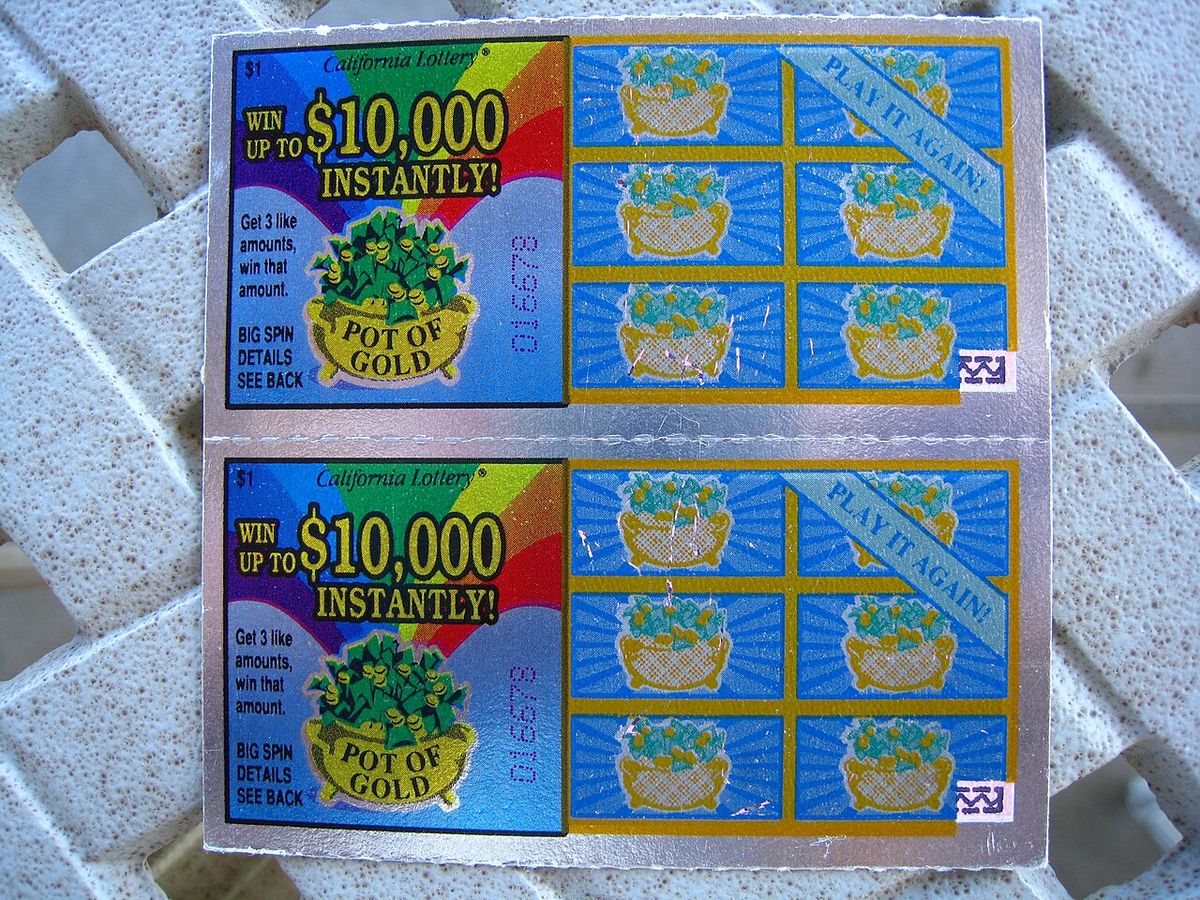
Scratchcard games require the player to remove the opaque covering from designated areas to reveal hidden play symbols, with the specific rules determining a win. The simplest format involves scratching areas to match three or more identical symbols, such as numbers or pictures, to win a prize. In some cases, the entire scratchable area needs to be scratched to see whether a prize has been won, as the card is printed either to be a winner or not. In other cases, some but not all areas have to be scratched, such as in a quiz where the area corresponding to the right answer is scratched.
The card becomes invalid if too many areas are scratched. After losing, one can scratch all areas to see what could have been won. More complex cards offer multiple ways to win on a single ticket, including matching symbols, adapting popular games like poker or blackjack, or revealing specific combinations across different game sections. Another variant is the break-open or pull-tab card, often used in bingo halls where they are sometimes called 'pickles'.
Break-open cards are often made of cardboard and contain perforated cover window tabs, behind which the combinations are printed. The purchaser must break open the card or pull up the pull-tabs to see the information printed within. The winning combinations are highlighted on the back of the card for easy verification. In the digital space, online and mobile app versions simulate the scratching experience using software, though these are distinct from the physical tickets sold at retail. Canadian provincial lotteries offer a wide range of scratch ticket price points to cater to different players, with a clear trend towards offering more expensive tickets that feature larger potential prizes. Common price tiers are structured to provide options for every budget, from low-cost impulse buys to premium experiences. The available price points, as filtered on lottery corporation websites, systematically include $1, $2, and $3 tickets for low-cost play and frequent purchase. $5 and $10 tickets are among the most popular and widely available price points.
$20, $30, and $50 tickets often feature more elaborate games and larger potential prizes, and $100 tickets represent the premium end of the instant game market with the highest top prizes. The prize structure varies directly with the ticket price, with higher-cost tickets generally offering a greater number of top-tier prizes and better overall odds. There is a global trend towards more expensive scratchcards (20 to 50 USD) that have prizes in the millions of dollars. However, many such instant tickets sold in the United States, especially in Massachusetts and New York, do not pay top prizes instantly, but rather over many years with no cash lump sum option, a practice less common in Canada.
The Canadian scratchcard landscape and operators
Scratchcard gambling in Canada is administered by provincial and regional lottery corporations, which are crown corporations or government agencies with a monopoly on legal lottery games. Each entity is responsible for the sale, regulation, and distribution of profits from lottery games within its jurisdiction, ensuring all proceeds benefit the region. The major operators are the Ontario Lottery and Gaming Corporation (OLG), Loto-Québec, the British Columbia Lottery Corporation (BCLC), the Western Canada Lottery Corporation (WCLC serving Manitoba, Saskatchewan, Alberta, and the territories), and the Atlantic Lottery Corporation (serving Atlantic Canada). All profits from these scratch tickets remain within their respective regions, funding community initiatives, charities, sports programs, and government revenues.
Tickets are widely available at authorized retailers, including corner stores, gas stations, and grocery stores. These corporations frequently update their game portfolios, retiring old tickets and launching new ones to maintain player interest. Players can browse current and upcoming tickets on official websites, often filtering by price point from $1 to $100. The launch of new games is a regular occurrence, with schedules published showing releases planned into late 2026.
These organizations often run second-chance sweepstakes where non-winning tickets can be entered for additional prizes. This practice also helps control litter problems associated with improper ticket disposal. Since lottery tickets are considered bearer instruments under the Uniform Commercial Code in the United States, these promotions can be entered with non-winning tickets picked up as litter. The same principle applies in Canada regarding the bearer instrument status of tickets.
| Lottery Corporation | Jurisdiction | Example Scratch Game (2026) | Notable Feature or Update |
|---|---|---|---|
| Ontario Lottery and Gaming (OLG) | Ontario | Various instant games | Offers tickets with top prizes up to $10 million |
| Loto-Québec | Quebec | "50 $ en masse" ($5), "Pause-café" ($3) | Provides online scratch ticket options in addition to retail sales |
| British Columbia Lottery Corp. (BCLC) | British Columbia | Multiple Scratch & Win tickets | Draw times for lottery games changed to 8:30 p.m. PT in 2026 |
| Western Canada Lottery Corp. (WCLC) | Manitoba, Sask., Alta., Territories | Current & upcoming Scratch & Win | Website allows filtering of tickets by price and launch date. Sells break-open tickets. |
| Atlantic Lottery | Atlantic Canada | Scratch & Win tickets | Prominently states all profits stay entirely in Atlantic Canada |
Checking tickets, claiming prizes, and transparency
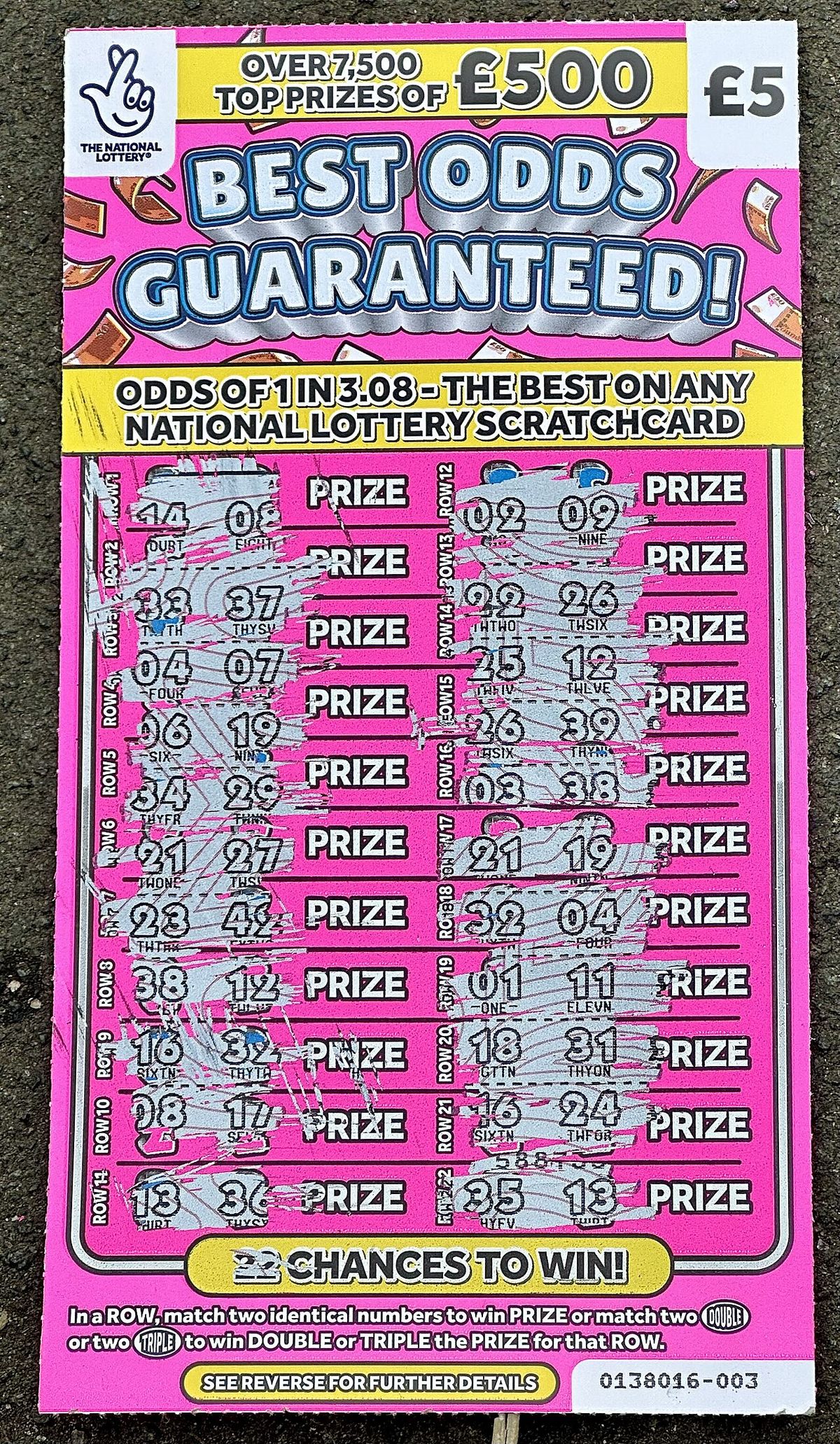
Determining if a scratchcard is a winner has been streamlined by technology, though the basic manual check remains an option. Players can manually compare revealed symbols to winning combinations printed on the ticket, but the definitive method is to scan the ticket's barcode, which is covered by the same opaque latex as the play area. In the United States, it is common to use a printed barcode to identify winning cards. Retailers also have terminal scanners to check tickets, providing an official validation.
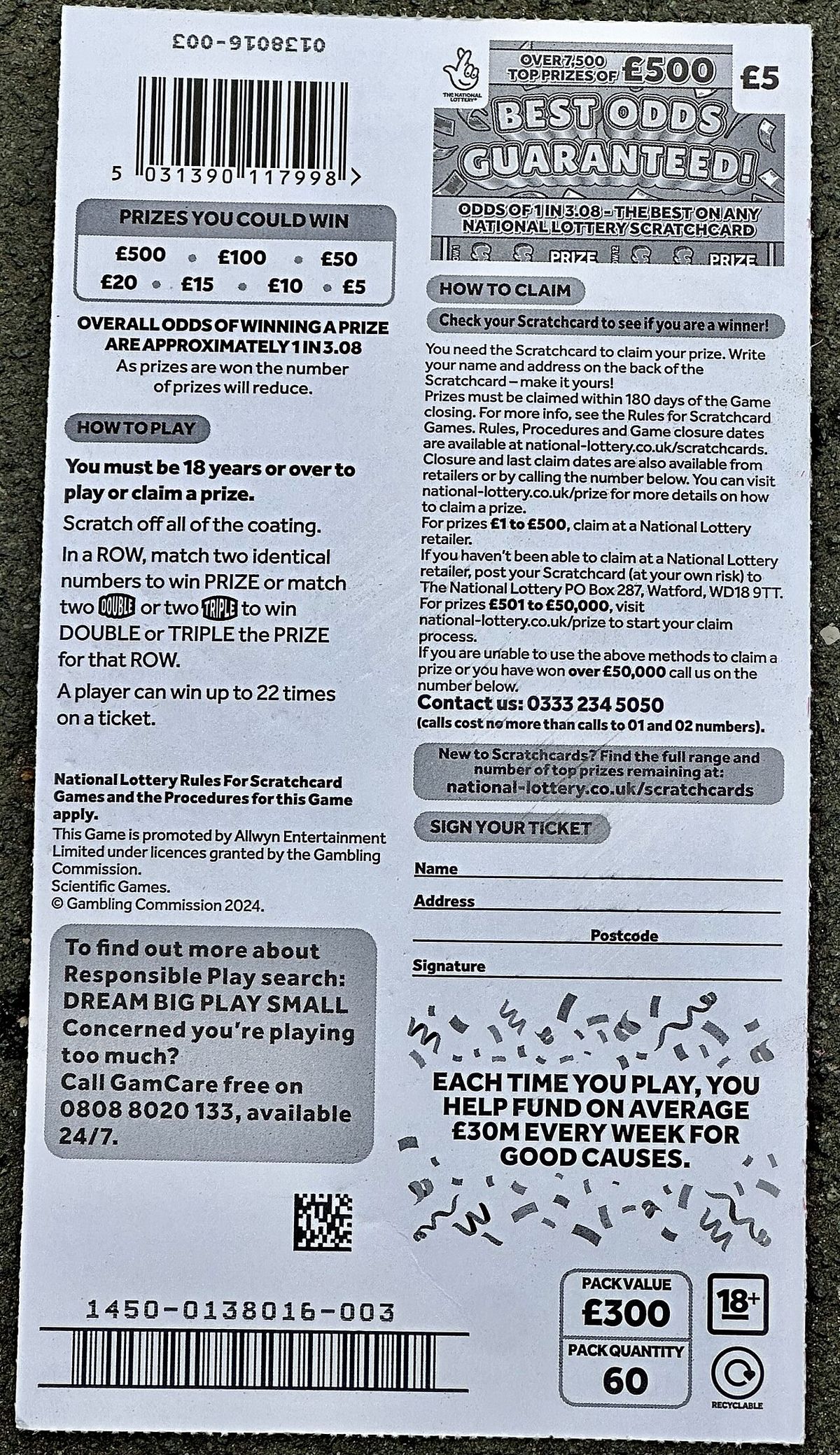
It is crucial for players to check the expiry date printed on the back of the ticket, as all prizes must be claimed before this date, a rule strictly enforced by all lottery corporations. For smaller prizes, claims can typically be made at any authorized lottery retailer. Larger prizes, usually above a threshold set by each provincial corporation, must be claimed in person at a lottery head office or through a formal mailed claim process. Players should sign the back of a winning ticket immediately to establish ownership.
Transparency regarding available prizes has become a standard practice following past controversies where games were sold after top prizes were claimed. Many lotteries now provide up-to-date information on top remaining prizes for specific games on their websites. This shift was often driven by consumer watchdog investigations and subsequent laws requiring disclosure. For example, in February 2018, The Guardian newspaper found that the UK's £250,000 Gold scratchcard game was still being sold after all 15 jackpots had been claimed.
A similar incident occurred in May 2018 with the 20X Cash Scratchcard. Modern lottery retailers may print daily or weekly game lists from their terminals that note games where jackpots have already been won. In the 21st century, there have been attempts to increase the odds of finding a prize-winning card based on statistics, by tracking the amount of prize money won and cards sold. Some lotteries make this information available free of charge to help promote their games.
The process for a player to fully check and understand their ticket involves several key steps. First, scratch the designated play areas completely to reveal all game symbols. Second, manually compare revealed symbols to the winning combinations listed on the ticket. Third, use a lottery app to scan the ticket's barcode or take it to a retailer for a terminal scan. Fourth, check the expiry date printed on the back of the ticket immediately.
- Scratch the designated play areas completely to reveal all game symbols.
- Manually compare revealed symbols to the winning combinations listed on the ticket.
- Use a lottery app to scan the ticket's barcode or take it to a retailer for a terminal scan.
- Check the expiry date printed on the back of the ticket immediately.
- Sign the back of the ticket if it is a winner to establish ownership.
- Follow the provincial claim instructions for the prize amount.
- For large prizes, contact the lottery corporation's customer care line for specific claim procedures.
- Scratch the designated play areas completely to reveal all game symbols.
- Manually compare revealed symbols to the winning combinations listed on the ticket.
- Use a lottery app to scan the ticket's barcode or take it to a retailer for a terminal scan.
- Check the expiry date printed on the back of the ticket immediately.
- Sign the back of the ticket if it is a winner.
- Follow the provincial claim instructions for the prize amount.
- For large prizes, contact the lottery corporation's customer care line, such as 1-800-561-3942, for specific claim procedures.
Odds, profitability, and consumer protections
The odds of winning on any given scratchcard are predetermined and printed on the ticket or available from the lottery operator, a legal requirement in Canada. Overall odds, which include all prize tiers from small amounts to the jackpot, typically range from less than 1 in 5 to about 1 in 2.5. This means a significant portion of tickets are non-winners. The lotteries remain profitable because the low probability of winning the largest prizes, combined with continuous high-volume sales, ensures that total prize payouts are less than total revenue.
Hypothetically, large early payouts may exceed ultimate sales before expiration of the game card series. However, the low odds of winning and players who buy cards unaware of the low return offset these losses, so the lottery still makes a profit. A trend towards more expensive tickets priced between $20 and $50, and even $100, with top prizes in the millions, leverages the appeal of a large jackpot to drive sales. These tickets have extremely long odds of winning the maximum prize.
Consumer protections have evolved to address issues of transparency and fraud. In the past, some lotteries continued to sell games after all major prizes were claimed. Now, Canadian lotteries generally provide updated information on prize status. Many jurisdictions have laws requiring disclosure of remaining top prizes following media exposés.
Beyond the gambling context, the scratch-off format is widely misused in fraudulent schemes. A widespread misuse is the free-of-charge distribution of cards offering a range of prizes. Cards always reveal that a prize has been won, but the nature and value can only be determined by phoning a premium rate telephone claim line. Calls to this number are designed by the promoter always to take several minutes, and the prize won is always of far less value than the cost of the call. Regulatory authorities for telephone services have been taking action against such schemes, issuing warnings and large fines. Another form of protection involves the technology itself, as silkscreen latex panels that bond with the card body are more secure than adhesive labels. The industry must continually address challenges related to fraud prevention, including ticket counterfeiting and deceptive prize promotions.
Non-gambling applications and the future of scratchcards
Beyond gambling, scratchcard technology is used globally to securely convey confidential information without any element of chance, serving purely as a delivery mechanism. A common example is the prepaid phone or recharge card, where a Personal Identification Number (PIN) or Hidden Recharge Number (HRN) is hidden under a scratch-off layer. The card itself has no intrinsic value and is not a payment card. It is simply a vehicle to inform the purchaser confidentially of the code required to access the paid service, such as mobile phone minutes.
This application is crucial in markets where credit card transactions are less common, providing a secure, tangible method of distributing digital value. The technology ensures the PIN remains secret until purchase, protecting against theft or unauthorized use. It employs the same durable latex coating used on lottery tickets to prevent accidental revelation. The scratch-off layer balances durability with the need for easy removal by the legitimate owner.
The future of scratchcards involves both the continued evolution of physical tickets and the growth of digital simulations. Online versions of virtual scratchcards, which use software to simulate the scratching action, have been available since around 2010. These early versions utilized technologies like Flash and Java, and now more advanced mobile app platforms are common. These are offered both by some provincial lotteries and by online casinos.
Another technology-enabled form is mobile applications programmed by game developers and published on app stores like the Apple App Store or Google Play Store. The core appeal of instant gratification and simple gameplay continues to drive popularity in both physical and digital formats. However, the industry must continually address challenges related to fraud prevention. Ensuring the integrity of the scratch-off mechanism is vital for both gaming and secure data delivery purposes.
Questions about Scratchcard
How do I check if my scratch ticket is a winner?
You can check a scratch ticket by manually comparing the symbols you revealed to the winning combinations listed on the ticket. The most accurate method is to scan the barcode on the ticket, which is covered by the same latex as the play areas. Many provincial lottery apps allow you to scan the barcode with your mobile device for instant verification. Alternatively, you can take the ticket to any authorized lottery retailer, and they can scan it at their terminal. Always check the expiry date printed on the back of the ticket, as prizes cannot be claimed after this date.
What happens to unclaimed scratch ticket prizes?
Unclaimed scratch ticket prizes are retained by the provincial lottery corporation after the ticket's expiry date has passed. The allocation of these funds varies by province but typically contributes to overall lottery profits. These profits are often directed by law to provincial government revenues or community initiatives. In some jurisdictions, the funds from expired tickets are added to the prize pool for future games or specific beneficiary programs.
What are the biggest prizes available on scratch tickets?
Top prizes on scratch tickets vary by game and price point. As of 2026, some Canadian lottery corporations offer games with top prizes of $1 million. The largest top prize advertised is $10 million. These top-tier prizes are typically found on higher-priced tickets, such as those costing $20, $30, $50, or $100, following a global trend towards more expensive tickets with million-dollar prizes. The odds of winning these maximum prizes are extremely low, as detailed on the ticket or the lottery's website.
Are there online scratch tickets?
Yes, some provincial lottery corporations offer digital scratch tickets that can be purchased and played online through their official websites or apps. For example, Loto-Québec lists online scratch tickets alongside its retail games. These digital versions simulate the scratching experience using animation and software. It is important to distinguish these legally offered online games from scratchcard-style games found on unregulated casino or bingo sites, which are separate entities.
How can I find out what top prizes are left on a scratch game?
You can find out what top prizes are left by visiting the official website of your provincial lottery corporation. These websites often have a section titled 'Top Remaining Prizes' or 'Unclaimed Prizes' for scratch games. The lists show how many of the top prizes for specific games are still available to be won. This information is updated regularly, and retailers may also access updated game lists through their lottery terminals. Some lotteries began this practice after laws were passed requiring disclosure following media exposés.
Where can I buy scratch tickets in Canada?
Scratch tickets are sold at thousands of authorized retailers across each province, including corner stores, gas stations, grocery stores, and dedicated lottery kiosks. Tickets are only available within the province of the issuing lottery corporation, such as OLG in Ontario or BCLC in British Columbia. These tickets are a popular form of gambling due to their wide distribution and low cost. They are a bearer instrument, meaning the physical holder of the ticket is presumed to be the owner.
Sources and further reading
- Scratchcard (Wikipedia)
- Lotto Spot | The NEW Lotto Spot is coming soon! (lottospot.ca)
- Scratching Cards and Scratch Card Printing (printwow.ca)
Checked by the Nosy Mag desk. Last updated 2026-11-10.