Black Donnellys
The Black Donnellys were an Irish Catholic immigrant family who settled in Biddulph Township, Ontario, in the 1840s. Their decades-long, violent feud with neighbours culminated in a vigilante massacre on February 4, 1880, where five family members were murdered and their farmhouse burned. The case became one of the most infamous crimes in 19th-century Canadian history. No one was ever convicted for the murders. The story remains a part of Canadian folklore.
Immigration and Settlement in Biddulph Township
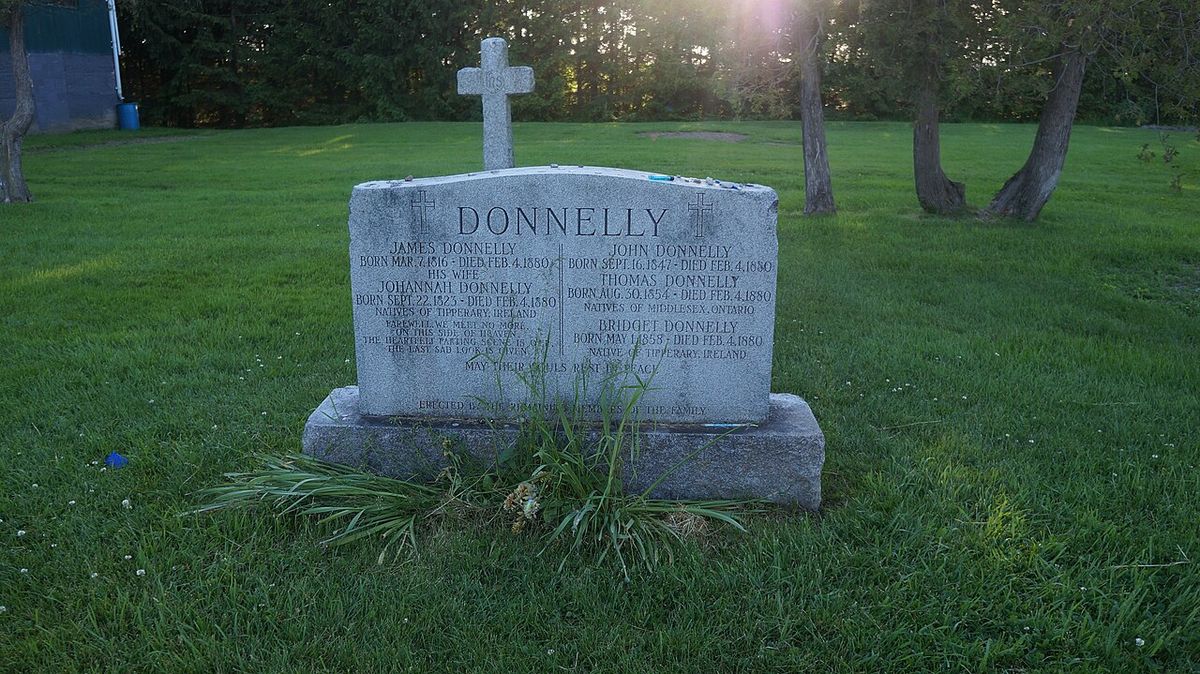
James Donnelly, born March 7, 1816, and Johannah Magee, born September 22, 1823, emigrated from Moneygall, County Tipperary, Ireland, to Upper Canada in 1842 with their first child, James Jr. They were part of a large wave of Irish Catholics fleeing the Great Famine of 1845-52. The family initially settled as squatters on a concession road in Biddulph Township in southwestern Ontario, about 25 kilometres northwest of London. This road earned the name the Roman Line due to the high concentration of Irish Catholic immigrants who populated it within a predominantly Protestant area. Over the next fifteen years, James and Johannah had seven more children: William (1845), John (September 16, 1847), Patrick (1849), Michael (1850), Robert (1853), Thomas (August 30, 1854), and Jennie (1857). James's niece, Bridget Donnelly (born May 1, 1858), also lived with them. The Donnellys' decision to squat on land owned by the Canada Company established an immediate and lasting conflict over property rights.
The Fatal Land Dispute and James Donnelly's Imprisonment
The property the Donnellys occupied was part of a lot originally owned by the Canada Company, sold to James Grace and later to John Grace. A neighbour, Patrick Farrell, had leased another portion of the same lot. In 1856, John Grace brought an ejectment action against James Donnelly in the Huron County Court of Common Pleas. The judge, recognizing the improvements Donnelly had made during his ten-year occupancy, split the 100-acre lot, awarding 50 acres to Donnelly and 50 to Farrell. Hard feelings over this settlement remained. At a barn raising bee on Saturday, June 27, 1857, a fight erupted between James Donnelly and Patrick Farrell. Farrell suffered a fatal blow to the head from a handspike thrown by Donnelly and died two days later. James Donnelly fled and remained in hiding for almost two years. He finally turned himself in to Justice of the Peace Jim Hodgins in 1859. James was convicted of murder and sentenced to hang on September 17, 1859. Johannah Donnelly organized a petition for clemency, gathered many signatures, and walked to the Huron County Courthouse in Goderich to present it. The petition was successful, and on the recommendation of Attorney General John A. Macdonald, the sentence was commuted to seven years imprisonment in Kingston Penitentiary.
Family Life and the Donnelly Stagecoach Feud
The Donnelly boys grew into hardworking but combative young men. On May 24, 1873, William Donnelly started the Donnelly Stagecoach Line, operated with his brothers Michael, John, and Thomas. The line ran between London, Lucan, and Exeter and was a significant success, rivaling the official mail stage that had operated since 1838. The competition soon turned violently personal when Patrick Flanagan purchased a rival line from a man named Hawkshaw in October 1873, determined to drive the Donnellys out of business. This ignited the Stagecoach Feud, characterized by arson, smashed coaches, savagely beaten or killed horses, and burned stables. The Donnellys were widely blamed for this wave of violence, though few convictions were secured against them. This period cemented their reputation as a constant source of strife. The feud, combined with the construction of the Grand Trunk Railway to Sarnia, undermined the stagecoach business, and by the spring of 1877, the Donnelly brothers abandoned their line.
The family's legal troubles were extensive and involved both the men and Johannah. Their recorded encounters with the law included charges for assault, verbal assault, arson, property damage, trespassing, theft, attempted murder, the 1857 murder of Patrick Farrell, and assaulting a police officer. Johannah was noted for frequently swearing at officers like Constable Carroll. While not found guilty of every accusation, their actions created a long and bitter list of enemies within Biddulph Township.
Rise of the Biddulph Peace Society and Vigilance Committee
In June 1879, Father John Connolly, the newly appointed priest of St. Patrick's Roman Catholic Church, created the Biddulph Peace Society. He asked all parishioners to pledge support and agree to have their homes searched for stolen property. The Donnellys refused to sign. The society aimed to enforce traditional Irish Catholic social codes, including a code of silence and sectarian separation from Protestants, which the Donnelly family openly violated. In a notable incident, Father Connolly was reportedly preaching anti-Protestantism from the pulpit when James Donnelly stood up, denounced the sermon, and declared his family would thereafter attend the Catholic parish in London, Ontario. James Donnelly had donated money to help establish a local Anglican church, an act that outraged many in the community. By August 1879, a militant splinter group began holding covert meetings at the Cedar Swamp Schoolhouse. This group, which included Constable James Carroll and many local Irish Canadians with grievances against the Donnellys, formed the Vigilance Committee. Evidence suggests this committee or its individual members were responsible for subsequent arson, property damage, and violence in Biddulph, ultimately planning the massacre.
The Final Provocation and Planning of the Attack
The final provocation for the attack was the belief that the Donnellys had committed arson against Patrick Ryder's barn. After the fire, Father Connolly addressed his congregation, stating an 'evil had fallen among the community' and offering a $500 reward for the detection of the 'wicked persons.' Within the community, debates raged over the appropriate punishment, with some advocating fines and jail time and others favouring summary execution. The Vigilance Committee's original plan, formulated for the night of February 3, was to visit the Donnelly homestead, handcuff the men, escort them out, and hang them from a tree until they confessed. Surveillance was conducted on the property, with Jim Feeheley acting as a spy by visiting the house earlier on February 3 to assess the situation. The planners were unaware that John Donnelly had gone to stay with Big Jim Keefe to collect a vehicle for their trial the next day, and they did not expect the hired farmhand Johnny O'Connor to be inside the house that night. On the afternoon of February 3, James Donnelly Sr. had his son Thomas write a letter to their London lawyer, Alderman Edmund Meredith, complaining about their unjust arrest and the postponed trial. This letter was the last he ever sent.
The Massacre of February 4, 1880
Late on the night of February 3, members of the Vigilance Committee gathered at the Cedar Swamp Schoolhouse, drinking liquor they called the 'water of life' to numb their senses and bolster courage. Around midnight, a mob of approximately two dozen armed men walked three miles down the Roman Line toward the Donnelly homestead. They carried an array of weapons including firearms, a pitchfork, an axe, shovels, clubs, and a shortened wooden stake made of cordwood. Constable James Carroll entered the house first, taking handcuffs given to him by Constable Hodgins and cuffing the sleeping Thomas Donnelly. When James Donnelly Sr. awoke and demanded to see a warrant, Carroll gave the signal, and the mob stormed inside. A brutal beating ensued. James Donnelly Sr. was beaten severely, with James Maher repeatedly hitting his skull, causing fatal brain damage. Johannah Donnelly fought hard but was beaten to the floor by Carroll. Thomas, after briefly breaking free, was stabbed several times with a pitchfork by Tom Ryder outside, then carried back in and bludgeoned to death with a shovel. Bridget Donnelly, who had hidden upstairs, was found, beaten, and brought down. The family dog was also killed with a shovel for barking. Discovering John Donnelly was absent, the mob decided to set the house on fire with the four bodies inside. They then went to William Donnelly's house seeking John, found it empty, and proceeded to the home of John's fiancée, where they found and killed John Donnelly. Eleven-year-old Johnny O'Connor, hidden under James Donnelly's bed, witnessed the entire homestead attack and escaped the fire, becoming the sole eyewitness.
The Aftermath: Inquest, Trials, and Acquittals
On the day of the murders, February 4, coroner Thomas Hossack gathered a jury for an inquest into the 'suspicious' deaths. The sole eyewitness, Johnny O'Connor, and surviving son William Donnelly, who identified attackers from the mob at his brother John's murder, provided testimony. William was listed as the informant on the death certificates for all five victims, dated April 1 and 2, 1880, with the cause of death listed as 'supposed to be murdered.' Despite this, the legal proceedings failed utterly. Two major trials were held at the Middlesex County Courthouse in London. The first trial, in September 1880, ended with a hung jury. A second trial in January 1881 concluded with the judge directing the jury to return a verdict of 'not guilty.' Constable James Carroll was tried separately for the murder of Johannah Donnelly. This trial also ended in a hung jury, with one juror reportedly declaring he would not convict. No one was ever held legally accountable for the five murders. The case attracted international interest as details emerged of a factional feud originating in County Tipperary.
Composition of the Vigilante Mob
The Vigilance Committee mob comprised many local men from Biddulph Township, primarily from Irish Catholic families with long-standing grievances against the Donnellys. Contemporary accounts and later research have identified numerous alleged participants. These included 'Big' Jack Kennedy, William Feeheley, Pat Dewan, the Heenans (Dennis, Anthony and Michael), John Lanphier, James Harrigan, the Ryders (Mr. Ryder, Jim, Patrick Jr., 'Sideroad' Jim, Thomas and Daniel), Martin McLaughlin, John McLaughlin, Ted Toohey, John Cain, James Maher, John Quigley, Patrick Quigley, Patrick Breen, James McGrath, John Purtell, Michael Blake, John Ryan, Ned Ryan, Johnny Ryan, William Thompson, John Dorsey, John Bruin, Michael Madigan, and James Kenny. The size and composition of the group indicate the deep-seated and widespread nature of the hostility toward the Donnelly family within the community.
Cultural Legacy and Historical Memory
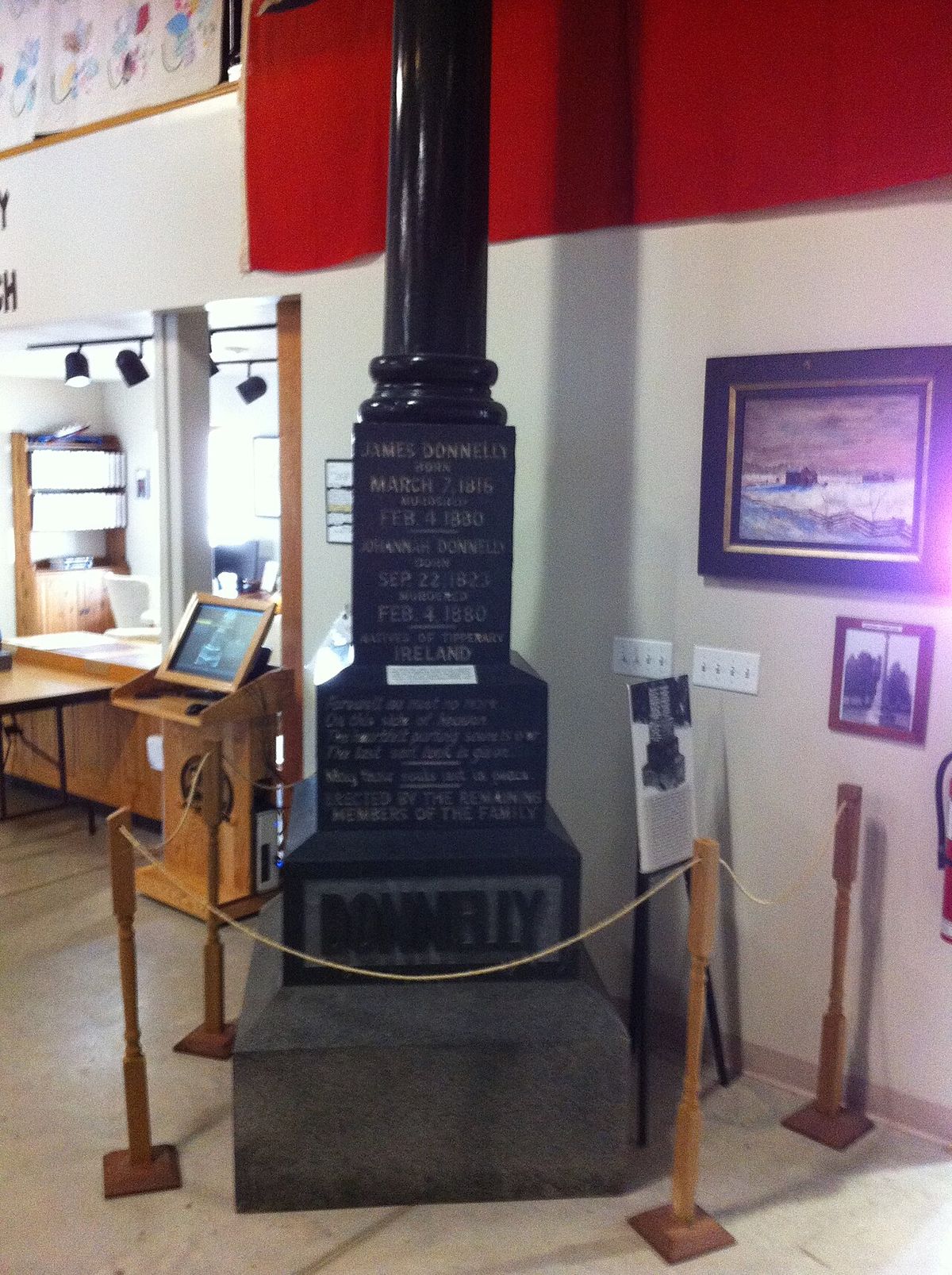
For most of the 20th century, the story was suppressed locally in Lucan and Biddulph. Despite this, public and artistic fascination never dimmed. The tale has spawned over one hundred factual and fictional accounts. Major works include T.P. Kelley's sensational 1954 book The Black Donnellys, Orlo Miller's historical account The Donnellys Must Die (1962), Ray Fazakas's meticulously researched The Donnelly Album (1977), and playwright James Reaney's acclaimed dramatic trilogy (1974-77). The story has also been featured in documentaries, podcasts, and television shows. In 1995, the Lucan and Area Heritage Society formed to document local history, culminating in the 2009 opening of the Lucan Area Heritage & Donnelly Museum. The Donnelly story endures as a complex narrative exploring immigration, frontier justice, sectarian conflict, vigilante violence, and the failings of a legal system.
Questions about Black Donnellys
Who were the Black Donnellys?
The Black Donnellys were an Irish Catholic immigrant family who settled in Biddulph Township, Ontario, in the 1840s. The family, consisting of parents James and Johannah and their eight children, became infamous for their long-running and violent feud with neighbours. The conflict culminated in the massacre of five family members by a vigilante mob on February 4, 1880. The nickname 'Black' is believed to stem from Irish sectarian codes, where those who fraternized with Protestants were deemed 'black,' as the Donnellys had Protestant friends.
What happened on the night of the Donnelly massacre?
In the early hours of February 4, 1880, a vigilante mob known as the Vigilance Committee attacked the Donnelly homestead. They beat to death James Donnelly Sr., his wife Johannah, their son Thomas, and their niece Bridget Donnelly inside the home before setting it on fire with the bodies inside. The mob then sought out another son, John Donnelly, at a separate location and killed him. The sole eyewitness to the homestead attack was an eleven-year-old farmhand, Johnny O'Connor, who hid under a bed and escaped.
Was anyone ever convicted for the Donnelly murders?
No one was ever convicted for the murders. Two major trials were held in London, Ontario, in 1880 and 1881. The first trial ended with a hung jury. At the second trial, the judge directed the jury to return a verdict of 'not guilty.' Constable James Carroll, a member of the mob, was tried separately for the murder of Johannah Donnelly, which also ended in a hung jury. Despite eyewitness testimony, the legal proceedings failed to secure any convictions.
Why were the Donnellys so hated by their neighbours?
The animosity stemmed from multiple sources over decades. It began with a violent land dispute in 1857 that resulted in James Donnelly killing a neighbour, Patrick Farrell. Later, the family's successful stagecoach business led to a destructive feud with rivals, involving arson and violence for which the Donnellys were often blamed. The family also defied social and religious norms by associating with Protestants and criticizing their priest, which alienated them from the predominantly Irish Catholic community.
What was the Biddulph Peace Society?
The Biddulph Peace Society was formed in June 1879 by Father John Connolly, the priest of St. Patrick's Roman Catholic Church. He asked parishioners to pledge support and allow their homes to be searched for stolen property, aiming to curb lawlessness. The Donnellys refused to sign. The society sought to enforce traditional Irish Catholic codes, including sectarian separation from Protestants. A militant faction splintered off in August 1879, forming the Vigilance Committee that is held responsible for planning and carrying out the Donnelly massacre.
What is the cultural significance of the Black Donnellys story in Canada?
The story of the Black Donnellys is a foundational piece of Canadian true crime and folklore. It represents themes of frontier justice, ethnic and sectarian conflict, vigilante violence, and a notorious failure of the legal system. The case has inspired a vast body of literature, drama, and media. For generations, it was a suppressed local history, but it is now actively studied and remembered through institutions like the Lucan Area Heritage & Donnelly Museum, opened in 2009.
Sources and further reading
- Black Donnellys (Wikipedia)
- The tale of The Black Donnellys brought to life in Picton (pictongazette.ca)
- The Donnellys (thecanadianencyclopedia.ca)
- The “Black” Donnellys, Canadian True Crime podcast (canadiantruecrime.ca)
- Donnelly History, Lucan (donnellymuseum.com)
Checked by the Nosy Mag desk. Last updated 2026-10-25.