Nvidia forecasts 70% revenue surge as AI demand outstrips supply
Nvidia projects explosive growth for next fiscal year while warning of persistent supply chain constraints in its latest earnings report, with AI computing demand showing no signs of slowing despite geopolitical and production challenges.
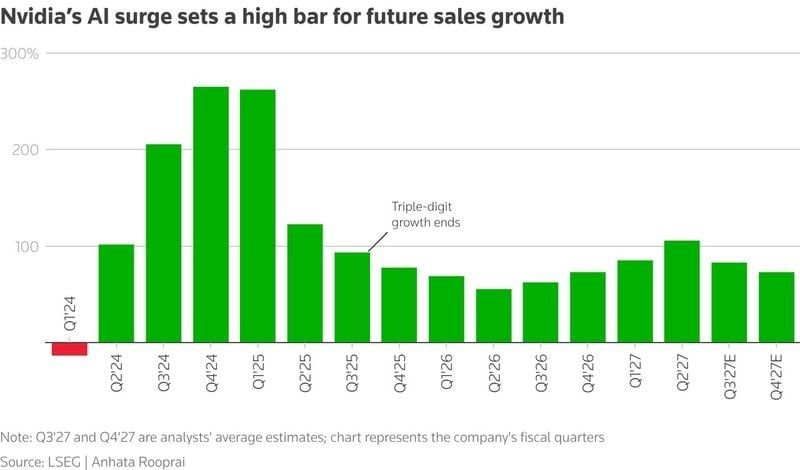
Nvidia has stunned investors with a projected 70 per cent revenue increase for its next fiscal year ending January 2028, according to its latest earnings report, demonstrating the chipmaker's central role in powering the global artificial intelligence revolution. The forecast sent shares up nearly eight per cent in Thursday trading as the company outlined aggressive expansion plans while acknowledging persistent supply constraints that continue to limit how quickly it can meet unprecedented market demand for AI computing power.
Unprecedented transparency signals confidence
The Santa Clara-based semiconductor giant broke with tradition by issuing this exceptionally rare fiscal year guidance, marking a strategic shift for a company that typically avoids long-term projections. Chief Executive Jensen Huang emphasized this departure from standard practice during the earnings call, stating "We've never forecast or never guided to a year in advance." The bold prediction significantly exceeds Wall Street analysts' average expectation of 44 per cent growth for the same period, according to LSEG data, reflecting Nvidia's confidence in the durability of the AI infrastructure buildout.
This optimism stems from rapidly broadening demand across multiple sectors beyond the initial wave of tech giant purchases. While cloud service providers originally drove most AI chip acquisitions, Nvidia now observes accelerating adoption from enterprise customers, government agencies and industrial users. Futurum Equities chief market strategist Shay Boloor noted "What makes (the forecast) even more credible is that demand is broadening beyond the original hyperscalers with AI clouds, enterprises, sovereign buyers and industrial customers now growing materially faster." This diversification suggests the AI revolution is transitioning from experimental phase to widespread practical implementation across global industries.
Data center dominance and product transitions
Nvidia's data center division continues to serve as its primary growth engine, with revenue more than doubling to $89 billion in the fiscal second quarter ended July - handily surpassing analyst estimates of $85.08 billion. The company revealed that its new Vera Rubin processor platform, now shipping to customers, will account for approximately 20 per cent of data center revenue this quarter, demonstrating successful execution of its product roadmap. Huang emphasized the platform's significance, stating "AI has reached its inflection point. It's doing useful work. Its tokens are productive and profitable. Now, compute is revenue," framing AI infrastructure as a mature revenue driver rather than speculative investment.
The chipmaker also disclosed that AI research labs like OpenAI will contribute roughly a quarter of total business next year, indicating healthy diversification beyond traditional cloud providers. Meanwhile, specialized cloud providers including Nebius and CoreWeave are dramatically expanding their Nvidia GPU capacity from three gigawatts last year to over eight gigawatts by year's end, creating additional demand channels. This expansion comes alongside a strengthened partnership with Amazon Web Services that will see two million additional Nvidia graphics processors deployed across Amazon's global infrastructure between 2027-2028.
Supply chain challenges temper growth
Despite overwhelming demand across multiple customer segments, Nvidia continues facing significant production limitations that prevent full capitalization on market opportunities. Chief Financial Officer Colette Kress provided sobering context during the analyst call, stating "We are seeing demand acceleration even at our scale. Customers' forecasts point to our growth doubling next year. However ... we are supply-constrained." The company expects component shortages and soaring memory prices to pressure margins through at least the fourth quarter, with projected margins bottoming at 71-72 per cent compared to about 74 per cent in the third quarter.
These constraints emerge as Nvidia navigates complex global supply chains while attempting to fulfill orders from hyperscalers, AI labs and enterprise clients simultaneously. The margin compression reflects both rising memory costs and the substantial investments required to expand production capacity. While the 70 per cent revenue forecast demonstrates Nvidia's pricing power and technological leadership, the supply limitations highlight how physical manufacturing realities can constrain even the most dominant players in the semiconductor industry.
Geopolitical complexities in China
Nvidia's business in China remains complicated by evolving U.S. export controls and geopolitical tensions. While Washington approved limited H200 AI chip sales to about ten Chinese firms including Alibaba, Tencent and ByteDance in May, deliveries stalled for months due to regulatory hurdles. A U.S. Commerce Department official recently confirmed shipments had begun but remained "very few," underscoring the fragile nature of this trade channel.
The company has pursued alternative strategies to maintain its China presence, including marketing its Vera CPU to Chinese clients in June with promised August availability. Notably, Nvidia excluded China data center revenue from its full-year outlook, reflecting the ongoing uncertainty surrounding technology transfers and the potential for further trade restrictions. This cautious approach demonstrates how geopolitical considerations now factor heavily into corporate planning for semiconductor firms with global operations.
Strong quarterly performance continues
For its fiscal second quarter, Nvidia reported revenue more than doubling to $96.22 billion, exceeding estimates of $92.17 billion. Adjusted earnings reached $2.22 per share versus the $2.10 analysts anticipated, continuing the company's pattern of outperforming expectations. The strong results and optimistic guidance propelled Nvidia shares upward, with the company forecasting third-quarter revenue of $108 billion (plus or minus two per cent), above the $104.19 billion consensus forecast.
Strategic implications for the AI industry
Nvidia's extraordinary growth projection and execution validate the company's position as the primary beneficiary of the AI infrastructure boom while confirming this technological shift shows no signs of near-term deceleration. The broadening customer base across cloud providers, enterprises, governments and specialized AI labs suggests the market is maturing beyond initial experimental deployments into widespread production use. However, the persistent supply constraints and margin pressures illustrate the physical limitations of semiconductor manufacturing capacity, even for the clear market leader.
The coming year will test whether Nvidia can successfully scale production to match its ambitious forecasts while handling an increasingly complex global trade environment. The company's ability to maintain technological leadership through product transitions like the Vera Rubin platform while managing geopolitical risks will determine whether it can fully capitalize on this unprecedented demand cycle. As the fundamental building block provider for AI development worldwide, Nvidia's fortunes remain inextricably linked to the broader trajectory of artificial intelligence adoption across industries and nations.