2028 US Presidential Election Betting Market Surpasses $700 Million in Trading Volume
Prediction markets show strong early interest in the 2028 US presidential race, with Polymarket traders placing over $700 million in wagers on potential candidates while strategizing around undervalued picks.
While the November 2024 midterms dominate current political coverage, speculative markets have already turned their attention to the 2028 US presidential election with remarkable intensity. Polymarket, a leading prediction market platform, reports trading volume exceeding $702.6 million on potential candidates, demonstrating how prediction markets have become early indicators of political sentiment even for elections years away from occurring.
The Mechanics of Political Prediction Markets
The Polymarket platform allows traders to buy and sell contracts tied to specific political outcomes, creating a financial marketplace that aggregates collective wisdom about electoral probabilities. Currently, the platform lists contracts for more than 50 potential candidates spanning the political spectrum from established figures like California Governor Gavin Newsom to long-shot candidates including celebrity Dwayne 'The Rock' Johnson. The market even includes a 2.5¢ contract on incumbent President Donald Trump despite the constitutional prohibition against third terms, illustrating how prediction markets sometimes incorporate legally impossible outcomes that nevertheless attract speculative interest.
This market functions differently from traditional political polling by creating financial incentives for accurate predictions. Traders who identify undervalued candidates early can profit as market perceptions change, while those who misjudge public sentiment face financial losses. The current $702.6 million in trading volume demonstrates significant interest in political speculation as an investment activity, not just as an academic exercise in forecasting.
Strategic Approaches to Early Election Trading
With party primaries not beginning until January 2028 and final candidates unknown, experienced traders are adopting specific strategies to handle this extended timeline. The predominant approach involves identifying undervalued contracts with plans to sell positions as candidate visibility increases during the election cycle. This allows traders to realize gains without waiting for the November 7, 2028 settlement date when final results determine contract payouts.
The extended timeframe creates unique liquidity challenges, as positions taken today may become difficult to adjust if trading volume later concentrates around eventual frontrunners. Savvy traders monitor multiple factors including fundraising success, early primary state activity, and media visibility to identify optimal exit points before nomination battles conclude. This requires continuous attention to political developments rather than a set-and-forget investment approach.
Democratic Party Contenders and Market Dynamics
The current market assigns Democrats a 60% probability of winning the presidency, reflecting favorable political conditions that include strong congressional prospects. Traders give Democrats 50% odds of securing both Senate and House majorities in the upcoming midterms, suggesting confidence in the party's near-term political momentum.
Pennsylvania Governor Josh Shapiro exemplifies how prediction markets can undervalue candidates focused on governing rather than national profile-building. Despite strong midterm polling projecting a decisive reelection victory with 50-55% of the vote and a 97% market probability of retaining office, his presidential contract trades at just 3.3¢. This discrepancy stems from his deliberate avoidance of early primary state campaigning in favor of state governance, reducing his current national visibility.
Shapiro's $30 million campaign fund and centrist positioning make him particularly interesting to market participants. His alignment with the Democratic Party's center-left faction is generally viewed as more electable than progressive alternatives in general elections. Market analysts anticipate his value rising significantly following a strong midterm performance that raises his national profile.
The Progressive and Republican Fields
Representative Alexandria Ocasio-Cortez leads the progressive wing with a 20% chance of securing the Democratic nomination, translating to a 13% presidential win probability. Her current 13.3¢ contract price presents potential value if she maintains progressive momentum through 2028, though her path would require expanding her appeal beyond the party's left flank.
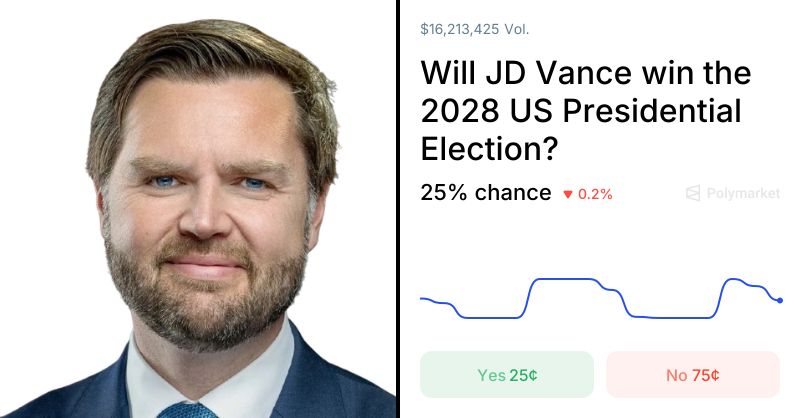
On the Republican side, Vice President JD Vance leads the field with a 25% win probability but his 24.9¢ price offers limited upside potential. More intriguing is Secretary of State Marco Rubio at 8.6¢, who benefits from foreign policy credentials and stronger polling against potential Democratic opponents. Rubio's appeal among Hispanic voters, who comprise the nation's second-largest voting demographic, provides a distinctive advantage in a general election scenario.
Florida Governor Ron DeSantis represents an interesting case study in political rehabilitation at just 2.4¢. Despite his unsuccessful 2024 primary bid, he retains a 57% approval rating in Florida that exceeds Trump's 48% and will be free to campaign nationally after 2026 due to term limits. At 47 years old, DeSantis offers Republicans a younger generational option who could potentially rebuild bridges with the establishment wing after his 2024 concession.
Long-Term Considerations for Market Participants
The extended timeline until the 2028 election creates unique challenges that distinguish political prediction markets from other forms of speculative trading. Unlike sports betting markets that resolve within days or weeks, political contracts require multi-year positions or carefully timed exits during campaign developments. This demands different risk management approaches and capital allocation strategies.
Market participants must also consider the evolving regulatory landscape for prediction markets, which exists in a legal gray area in some jurisdictions. While these markets provide fascinating insights into collective political forecasting, they remain speculative instruments subject to unexpected political developments, campaign missteps, and black swan events that could dramatically reshape the electoral landscape over the next four years.
For those interested in participating, Polymarket offers a $20 trading bonus with promo code CORG for new users who deposit $10, providing an opportunity to engage with one of the most active political prediction markets while gaining firsthand experience with this growing form of political speculation.
The substantial trading volume in the 2028 presidential market underscores how prediction markets have become not just forecasting tools but active marketplaces that reflect and potentially influence political narratives years before voters cast ballots. As the election cycle progresses, these markets will serve as dynamic indicators of shifting political fortunes, campaign strategies, and evolving voter sentiment in the post-Trump political era.