Odds
In probability theory and gambling, odds provide a measure of the likelihood of a particular outcome. They are a numerical expression used to quantify risk and potential payout. Odds are presented in several standard formats, including American (moneyline), decimal, and fractional, each conveying the same underlying probability and payout information in a different notational system.
Understanding Odds Formats
Betting odds are communicated in three primary formats, each prevalent in different regions but all representing the same core information. American odds, also known as moneyline odds, are standard in the United States. They are expressed as either a positive or negative number relative to a base of 100. A positive number, such as +250, indicates the underdog and shows how much profit a $100 wager would yield. A negative number, such as -150, indicates the favourite and shows how much must be wagered to win $100. Decimal odds are common in Europe, Australia, New Zealand, Canada, and Singapore. They represent the total return for every unit staked, including the original wager. For instance, decimal odds of 2.50 mean a $1 bet would return $2.50 total. Fractional odds, traditional in the United Kingdom and Ireland and common in horse racing, are expressed as a fraction like 5/1. The numerator shows the potential profit, while the denominator shows the stake required. Odds of 5/1 mean a $1 bet would profit $5, returning $6 total. All three formats are mathematically interchangeable.
The choice of format often reflects regional tradition and the type of betting. American odds are intuitive for spread betting and moneylines. Decimal odds are favoured for their simplicity in calculating total returns, making them popular for online betting globally. Fractional odds remain entrenched in horse racing and futures markets. Modern betting calculators allow users to translate between these formats to compare prices. A variation of fractional odds is known as Hong Kong odds, which are decimal. For example, UK odds of 6/5 are equivalent to Hong Kong odds of 1.2.

The Mathematics of Odds and Probability
Odds have a direct and calculable relationship with probability, a concept rooted in both gambling and statistics. In statistical terms, the odds in favour of an event are the ratio of the probability that the event will happen to the probability that it will not happen. Mathematically, if the probability of success is p, the odds in favour are p/(1-p). This relationship allows for conversion between the language of odds and the language of probability. In a finite set of equally probable outcomes, odds can be derived directly from counts. If an event can occur in W ways and fail to occur in L ways, the odds in favour are W:L. The probability p is then W/(W+L). For instance, the odds that a randomly chosen day of the week is during a weekend are 2:5, while the probability is 2/7. A key insight for bettors is the concept of implied probability, which is the win percentage derived from the sportsbook's posted odds. This calculated figure includes the bookmaker's margin, or vig. For standard odds of -110 on both sides of a point spread, the implied probability for each side is approximately 52.38%, summing to 104.76%. The excess over 100% represents the book's built-in advantage.
- Odds in favour: Ratio of probability of success to probability of failure (p/(1-p)).
- Odds against: The inverse ratio ((1-p)/p).
- Converting American odds: For +X, implied probability = 100 / (X + 100). For -X, implied probability = X / (X + 100).
- Converting decimal odds: Implied probability = 1 / decimal odds.
- Converting fractional odds (a/b): Implied probability = b / (a + b).
Understanding the mathematical relationships enables bettors to evaluate whether a sportsbook's implied probability aligns with their own assessment. The gap between the bettor's estimated probability and the probability implied by the odds is the basis for identifying value bets. Odds range from 0 to infinity, while probabilities range from 0 to 1. These values are related by simple formulas. Given probability p, the odds as a number are of = p/(1-p). Conversely, given odds of, the probability is p = of/(of+1).
Common Bet Types and Their Odds
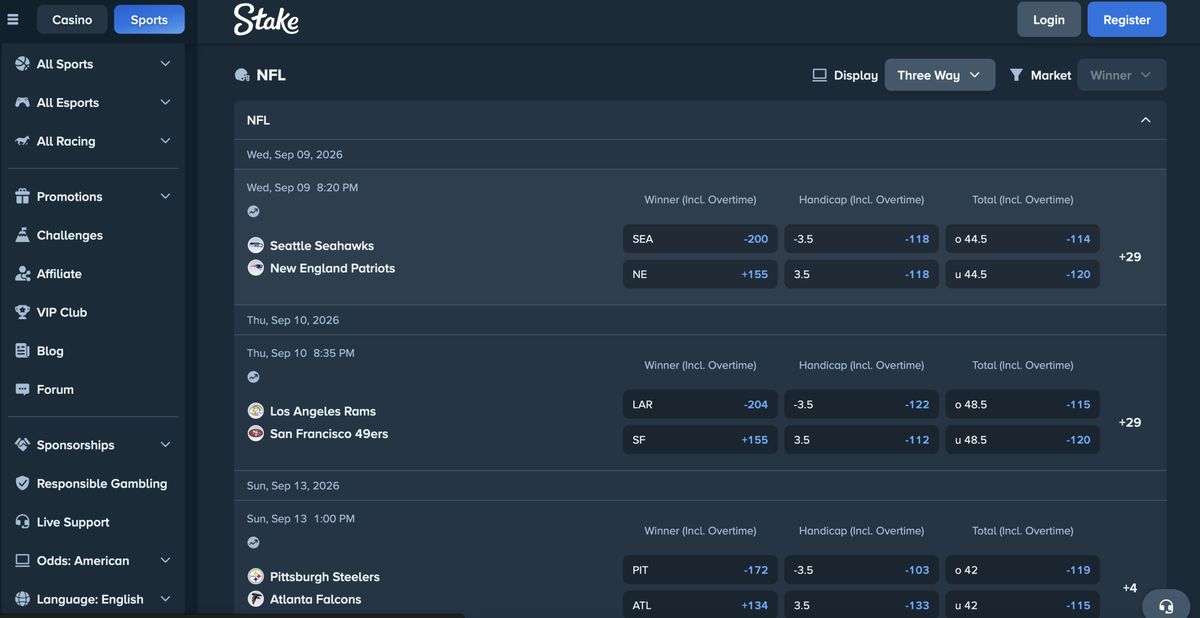
Sportsbooks offer a variety of wager types, each using odds to define the terms of the bet. The simplest is the moneyline bet, a wager on which team or competitor will win an event outright. Odds are presented in the standard formats, with favourites at negative American odds and underdogs at positive odds. Point spread betting is designed to level the playing field between unevenly matched teams by applying a handicap. The favourite must win by more than the spread, while the underdog must lose by less than the spread or win outright. Spread odds are typically set at -110 for both sides. Totals betting, or over/under, involves wagering on whether the combined score of both teams will be over or under a number set by the sportsbook. Like spreads, totals often carry odds of -110. More complex bet types include parlays, which combine multiple selections into one wager for a higher potential payout, and prop bets, which focus on specific events within a game unrelated to the final outcome. Live or in-play betting allows wagers to be placed after an event has started, with odds updating dynamically. A Canadian bet is a specific type of combination wager involving five selections and 26 separate bets: 10 doubles, 10 trebles, five four-fold accumulators, and one five-fold accumulator. This wager does not include singles, requiring at least two selections to win for a return. The stake is multiplied by 26.
| Bet Type | Description | Typical Odds Example |
|---|---|---|
| Moneyline | Wager on which team or competitor will win an event outright | -150 (favourite), +250 (underdog) |
| Point Spread | Favourite must win by more than the spread, underdog must lose by less than the spread or win outright | -110 for both sides |
| Totals (Over/Under) | Wager on whether the combined score of both teams will be over or under a set number | -110 |
| Parlay | Combines multiple selections into one wager for a higher potential payout | Varies based on selections |
| Prop Bet | Focuses on specific events within a game unrelated to the final outcome | Varies |
| Canadian Bet | Combination wager involving five selections and 26 separate bets | Varies based on selections |
How Sportsbooks Set and Adjust Odds
Sportsbooks aim to balance the money wagered on both sides to guarantee a profit regardless of the result. The primary mechanism for this is the vig, or juice, which is the built-in margin on a bet. On a standard point spread or total with odds of -110 for both sides, the sportsbook collects $110 from bettors on each side. If the total handle is balanced, the book pays out $100 to the winning side plus the original $110 stake, collects the $110 from the losing side, and keeps the $10 difference as profit. This margin is reflected in the implied probabilities summing to over 100%. Odds can move based on betting action and new information like injuries. If lopsided betting heavily favours one side, the sportsbook will adjust the odds or the point spread to incentivize bets on the other side and rebalance their liability. This line movement is a key indicator of market sentiment. Sportsbooks also compete with each other, leading to slight variations in odds for the same event across different platforms. This variance is why line shopping is a critical practice for bettors. The art of bookmaking is in setting the odds low enough to have a positive expected value of profit while keeping the odds high enough to attract customers. A study on soccer betting found that the probability for the home team to win was generally about 3.4% less than the value calculated from the odds.
Using Odds Calculators and Converters
Odds calculators and converters are digital tools for both novice and experienced bettors. These tools allow users to input a stake and odds in one format to instantly calculate the potential payout, profit, and implied probability. This eliminates manual calculation errors and saves time when comparing lines across multiple sportsbooks that may use different formats. A typical calculator will have fields for the bet amount and the odds. Upon entry, it automatically populates the equivalent odds in other formats, the total return, the net profit, and the implied win percentage. The primary functions include converting between odds formats, calculating payouts for single bets, and determining the implied probability. More advanced calculators can handle complex wagers like parlays, accumulators, and the Canadian bet. By providing clarity on potential outcomes, these tools help bettors make more informed wagering decisions. They are essential for line shopping to find the best value across books. They also help bettors understand the vig or margin built into a market. Most converters are available for free on sports betting information websites.
- Converts between American, Decimal, and Fractional odds formats.
- Calculates total payout (stake + profit) and net profit.
- Derives the implied probability of the posted odds.
- Essential for line shopping to find the best value across books.
- Handles calculations for complex bets like parlays and accumulators.
- Helps bettors understand the vig or margin built into a market.
Odds in the Canadian Betting Context
The regulation of sports betting in Canada occurs at the provincial level, with each province operating its own legal online sportsbook or licensing private operators. Canadian bettors may encounter a mix of odds formats, though decimal odds are common on provincially run platforms. The Canadian market also sees significant activity on internationally licensed sportsbooks that accept Canadian customers, which often present odds in American or decimal formats. Understanding how to read and convert these odds is a practical necessity. Beyond format familiarity, the concept of value betting is universal. A bettor assesses the true probability of an outcome through research, then compares it to the implied probability offered by the sportsbook's odds. If the true probability is higher, the bet is considered to have positive expected value. This disciplined approach, coupled with tools like odds calculators and a commitment to responsible gambling practices, forms the basis of a strategic engagement with sports betting for adults in Canada. The provincial regulatory framework means availability and specific offers can vary, but the mathematical principles of odds and probability remain constant.
Historical Development and Broader Usage
Phrases like ten to one to describe long risks were used in the 16th century, as seen in the works of William Shakespeare. The sixteenth-century polymath Gerolamo Cardano demonstrated the efficacy of defining odds as the ratio of favourable to unfavourable outcomes. This historical usage shows that odds have long been an intuitive way for people to express comparative likelihood and risk in everyday language. In modern statistics, odds and related ratios like odds ratios and log-odds are fundamental tools. They are often more natural than raw probabilities in fields like logistic regression, clinical trial analysis, and sequential decision making. The odds ratio is a central measure in epidemiological and medical research that compares the odds of an event across two different groups. In a clinical trial, an odds ratio can quantify how much more likely a treatment group is to experience a specific outcome compared to a control group. This application demonstrates that the mathematics of odds provides a crucial framework for analyzing binary outcomes and relative risks in many scientific disciplines. The use of odds thus extends far beyond gambling into professional fields.
Questions about Odds
How do you calculate payout from betting odds?
The payout calculation depends on the odds format. For American odds, a positive number (+X) shows profit on a $100 bet, so +250 means a $100 bet wins $250 profit, returning $350 total. A negative number (-X) shows the stake needed to win $100, so -150 requires a $150 bet to profit $100, returning $250 total. For decimal odds, multiply your stake by the decimal number to get the total return. A $10 bet at 2.50 odds returns $25. For fractional odds (a/b), profit is (stake * a/b), so a $10 bet at 5/1 yields $50 profit plus the $10 stake. Using an online odds calculator automates these conversions.
What is an odds converter and how does it work?
An odds converter is a tool that translates betting odds from one format to another. It works by using the mathematical relationships between American, decimal, and fractional odds. For example, American odds of +200 are equivalent to decimal odds of 3.00 and fractional odds of 2/1. You input the odds in any one format, and the converter displays the corresponding values in the others. This is essential for comparing lines from different sportsbooks that may use different formats. Most converters are available for free on sports betting information websites.
What is implied probability in betting odds?
Implied probability is the percentage chance of an outcome occurring as suggested by the betting odds. It is calculated by converting the odds into a probability figure. For American odds, the formula for +X is 100 / (X + 100), and for -X it is X / (X + 100). For decimal odds, it is 1 / decimal odds. For fractional odds (a/b), it is b / (a + b). The sum of the implied probabilities for all possible outcomes in a market will exceed 100%. The excess is the sportsbook's margin or vig.
What is a Canadian bet in sports betting?
A Canadian bet is a type of combination wager involving five selections. It consists of 26 separate bets: 10 doubles, 10 trebles, five four-fold accumulators, and one five-fold accumulator. It does not include any single bets, meaning at least two selections must win to generate any return. The total stake is 26 times the unit stake. A $5 Canadian bet costs $130 total. The potential returns can be high if multiple selections win, as the winnings from the doubles and trebles can compound.
What does -110 mean in betting odds?
In American odds, -110 is a very common price on point spreads and over/under totals. The minus sign denotes the favourite to cover the spread or hit the total. The -110 price on both sides incorporates the sportsbook's vig. It means a bettor must risk $110 to win $100. The implied probability for each side is approximately 52.38%, which sums to over 100%, ensuring the book's profit if betting is balanced.
How do sportsbooks use odds to ensure profit?
Sportsbooks set odds to balance the money wagered on both sides of an event, guaranteeing a profit through the vig. The odds include a built-in margin so the implied probabilities sum to more than 100%. For example, with -110 odds on both sides, the implied probability is about 104.76%. The book collects more in losing wagers than it pays out on winning ones. If betting becomes lopsided, the book adjusts the odds to attract bets on the other side and manage its risk.
Sources and further reading
- Odds (Wikipedia)
- Covers.com, Sports Betting Odds, Lines, Picks & News 2026 (covers.com)
- Sports Betting Odds, Vegas Odds, Futures & Game Lines for 2026 (vegasinsider.com)
- Best Online Sportsbooks & Betting Sites (2026) (bettingpros.com)
- Betting Odds: Moneylines, Point Spreads & Totals for Today (sportsbookreview.com)
- Betting Odds Calculator & Converter (actionnetwork.com)
- Betting Odds Calculator & Converter Tool (rotowire.com)
Checked by the Nosy Mag desk. Last updated 2026-11-12.