Nunavut
Nunavut is the largest, northernmost, and newest territory of Canada, officially established on April 1, 1999. Created through the Nunavut Act and the Nunavut Land Claims Agreement, it represents a landmark achievement in Indigenous self-government, providing the Inuit with a distinct territory for self-determination. Encompassing a vast portion of the Canadian Arctic Archipelago and mainland, Nunavut is a region of profound cultural significance and stark natural beauty. Its creation marked the first major change to Canada's political map in half a century and continues to shape national conversations on reconciliation, sovereignty, and development in the North.
History and Creation
The human history of the region now known as Nunavut stretches back millennia. The area was first populated around 4,500 years ago by the Pre-Dorset culture, a Paleo-Eskimo people who migrated east from the Bering Strait. They were succeeded by the Dorset culture approximately 2,800 years ago. The ancestors of the modern Inuit, the Thule people, began migrating from Alaska into the region by the 11th century and had settled most of modern Nunavut by 1300, completely replacing the Dorset culture. European exploration began in 1576 with Martin Frobisher, who made the first recorded European contact with the Inuit while searching for the Northwest Passage and mistakenly believed he had found gold in Frobisher Bay.
The 20th century saw profound upheaval, including the controversial High Arctic relocations of the 1950s, where Inuit from Nunavik were moved to Resolute and Grise Fiord. They faced starvation and harsh conditions in an unfamiliar environment. The Royal Commission on Aboriginal Peoples issued a critical report on the relocations in 1994, and in 2010 the Canadian government formally apologized and paid compensation. The modern political movement for Nunavut gained momentum in the 1970s through Inuit activism and land claims negotiations led by the Inuit Tapiriit Kanatami. A plebiscite in 1982 showed majority support in the Northwest Territories for division along ethnic lines.
The Nunavut Land Claims Agreement was completed in September 1992 and ratified by nearly 85 percent of Inuit voters in a referendum. The Nunavut Land Claims Agreement Act and the Nunavut Act were passed by the Canadian Parliament on July 9, 1993. This agreement led to the official birth of the Territory of Nunavut on April 1, 1999. A further historic step in self-determination was taken on January 18, 2024, with the signing of the Nunavut Lands and Resources Devolution Agreement, transferring control over land and resources to the territorial government. This agreement means decisions about Nunavut's future are now made in Nunavut by its people.
Geography and Climate
Nunavut is a territory of immense scale, covering over 1.9 million square kilometres of land and 157,077 square kilometres of water, representing 21 percent of Canada's total area. If it were a country, Nunavut would rank as the 15th largest in the world by area. It comprises a major part of mainland Northern Canada, most of the Arctic Archipelago, and all islands in Hudson Bay, James Bay, and Ungava Bay, including Akimiski Island and the Belcher Islands. Its boundaries include long land borders with the Northwest Territories and Manitoba, and it shares maritime borders with Quebec, Ontario, and Manitoba. The territory is divided into three administrative regions: Qikiqtaaluk (Baffin), Kivalliq, and Kitikmeot, each with distinct geological and cultural characteristics.
The geography features dramatic extremes, from the towering Barbeau Peak on Ellesmere Island to the expansive tundra of the mainland. Nunavut's climate is predominantly polar, with very cold subarctic conditions in more southerly continental areas. The territory includes Alert, the world's northernmost continuously inhabited place, and the Eureka weather station, which has the lowest average annual temperature in Canada. The region is warming at about twice the global average, a fact that profoundly affects hunting, travel, and infrastructure due to thinning ice and permafrost melt. Communities are isolated, accessible only by air or sea, contributing to the territory's status as the least densely populated major country subdivision in the world, with a density of 0.022 people per square kilometre.
Demographics and Society
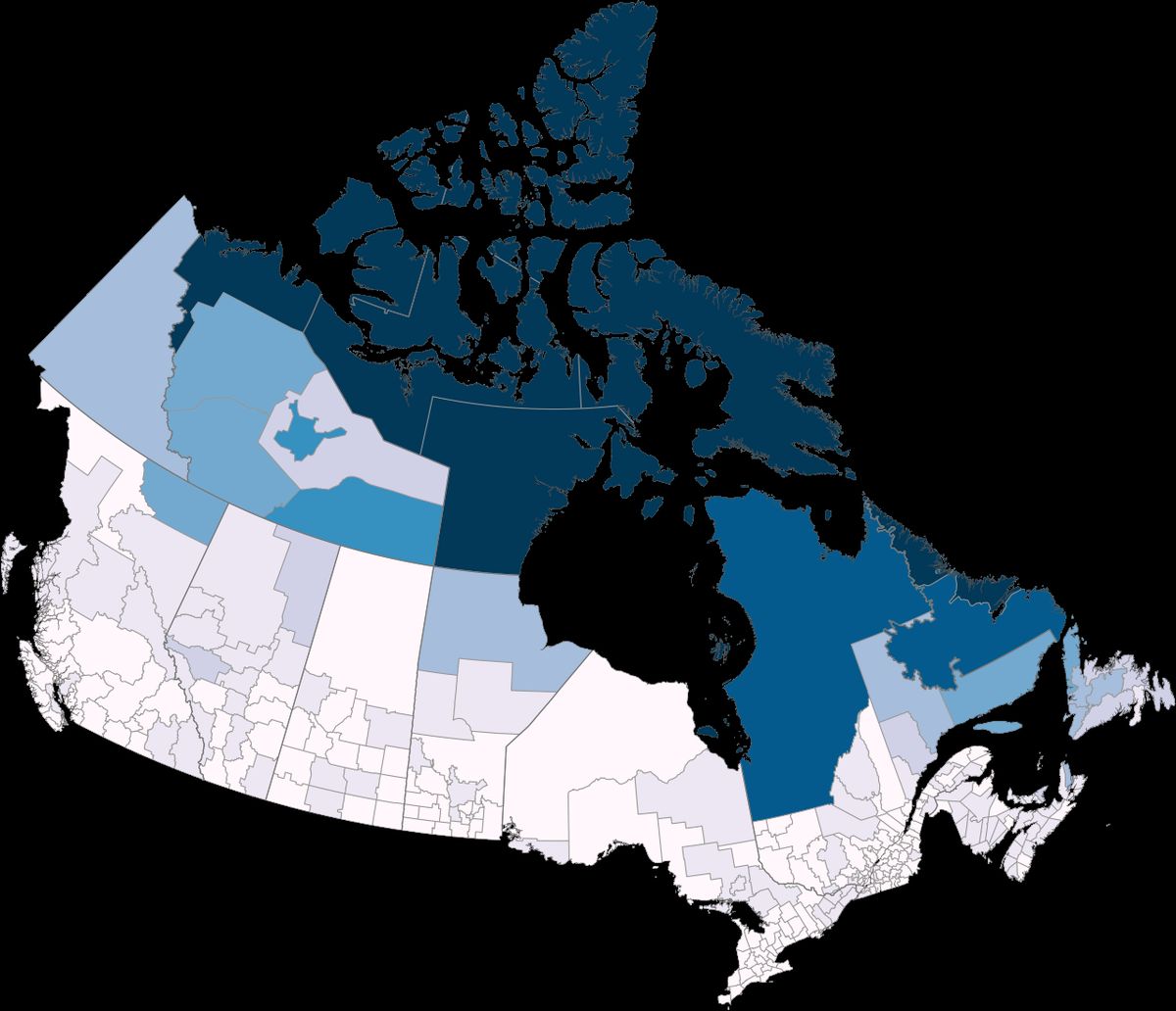
Nunavut's population was 36,858 in the 2021 census, with Inuit constituting 84.3 percent of residents, or 30,865 people. First Nations people made up 0.5 percent, Métis 0.3 percent, and non-Indigenous people 14.2 percent of the population. The population has experienced growth rates well above the Canadian average for decades, driven primarily by high birth rates. Between 2011 and 2016, Nunavut had the highest population growth rate of any Canadian province or territory at 12.7 percent. The territory is a young and culturally resilient society, with roughly 60 percent of Inuit reporting an ability to converse in Inuktut. However, significant social and economic challenges persist, including housing shortages and food insecurity, against a historical backdrop of colonization and forced assimilation.
The territory has three official languages: Inuktut (encompassing the dialects Inuktitut and Inuinnaqtun), English, and French. The 2016 census reported that 90.7 percent of Inuit in Nunavut could speak an Inuit language, but also that 5.8 percent of the total population knew neither English nor French. Efforts to preserve and promote Inuktut in education and public life are ongoing, with various instructional models implemented across communities, including the Qulliq Model for Inuktitut instruction and the Inuinnaqtun Immersion Model for language reclamation. About 1.6 percent of the population reported other religious affiliations including Aboriginal spirituality, Hinduism, Islam, and Buddhism.
Economy and Major Industries
The economy of Nunavut is a mix of public administration, resource extraction, and traditional activities. The territorial government is a major employer, while mining represents the most significant private sector industry. Three major mines were in operation as of recent years: the Meadowbank and Hope Bay gold mines, and the Mary River iron ore mine on northern Baffin Island. Baffinland Iron Mines Corporation, operating Mary River, is the territory's largest private employer with over 2,600 workers and accounted for 23 percent of Nunavut's economic activity in 2019. Historic mines in the territory include the Lupin gold mine, the Polaris lead and zinc mine, and the Nanisivik mine.
Other important economic sectors include arts and crafts, hunting, fishing, tourism, and transportation. Tourism saw travellers visit 134,000 times and spend $436 million in the second half of 2018, though two-thirds of those visits were by residents travelling within the territory. Of visitors from outside, the majority were business travellers, with only 14 percent visiting for leisure activities like dog sledding, wildlife safaris, and sea kayaking. The territory relies almost entirely on diesel fuel shipped from the south for electricity generation and heating, making energy costs high and driving government and community interest in renewable energy sources. Annual events like the Nunavut Mining Symposium in Iqaluit highlight the territory's economic potential and activities. The Canadian High Arctic Research Station in Cambridge Bay is also a centre for scientific and economic activity.
Culture, Media and the Arts
Nunavut has a rich and dynamic cultural landscape rooted in Inuit traditions. The performing arts include Inuit throat singing, drum-led dancing, and the internationally touring Igloolik-based circus collective Artcirq, which performed at the 2010 Olympic Winter Games. The territory has made a substantial mark on cinema, most notably through the Igloolik-based film company Isuma, co-founded by Zacharias Kunuk. Isuma produced the landmark film Atanarjuat: The Fast Runner, the first feature film written, directed, and acted entirely in Inuktitut, which won the Caméra d'Or at the 2001 Cannes Film Festival. Initiatives like the Nunavut Animation Lab, launched in 2006, and the Unikkausivut film collection, launched in 2011, further support Inuit storytelling and media production.
Media serving the territory includes the Inuit Broadcasting Corporation and the Canadian Broadcasting Corporation, which has production centres in Iqaluit and Rankin Inlet. Two regional weekly newspapers, Nunatsiaq News and Nunavut News/North, provide local coverage. Music in Nunavut blends traditional forms with imported influences like country, bluegrass, fiddling, and the button accordion. This cultural output occurs within a society where many families struggle with basic needs, demonstrating the resilience of Nunavummiut. Inuit communities have produced world-renowned artists and leaders who have advanced global Indigenous rights, with Inuit now working in many professions in the arts, medicine, government, and academia.
Governance and Recent Developments
Nunavut operates as a public government within the Canadian federation, meaning it represents all residents but was created to enable Inuit self-determination. The territorial government is based in Iqaluit and is structured with a legislative assembly and a premier. The Nunavut Lands and Resources Devolution Agreement, signed on January 18, 2024, is a major recent development. This agreement transfers decision-making authority over public lands, waters, and non-renewable resources from the federal government to the Government of Nunavut, a process known as devolution. It covers a vast area and includes provisions for resource revenue sharing, aiming to foster greater economic self-reliance.
This devolution agreement is viewed as a critical step in realizing the full promise of the Nunavut Land Claims Agreement, allowing decisions about the territory's future to be made by its own people. The agreement represents the culmination of years of negotiation and is a major milestone in the territory's political evolution. Other recent developments include the territory's management of the COVID-19 pandemic, where it imposed strict travel regulations and was the last place in North America to confirm a case in November 2020. Federal allocations for housing in Inuit Nunangat, which includes Nunavut, saw $51.6 million allocated for new and improved housing across the four Inuit regions in the 2025 to 2026 period.
Communities and Regions
The Qikiqtaaluk Region is the easternmost, encompassing Baffin Island and surrounding areas. Its 13 communities include the capital Iqaluit, as well as Arctic Bay, Cape Dorset (Kinngait), Clyde River, Grise Fiord, Hall Beach, Igloolik, Kimmirut, Pangnirtung, Pond Inlet, Qikiqtarjuaq, Resolute, and Sanikiluaq. The Kivalliq Region consists of the mainland west of Hudson Bay together with Southampton and Coats Islands. Its seven communities are Arviat, Baker Lake, Chesterfield Inlet, Coral Harbour, Naujaat, Rankin Inlet, and Whale Cove, an area characterized by great expanses of Arctic tundra.
The Kitikmeot Region is the most western, consisting of parts of Victoria Island and the adjacent mainland. Its five communities are Cambridge Bay, Gjoa Haven, Kugaaruk, Kugluktuk, and Taloyoak. These regions are marked by differences in geology, which have led to variations in traditional diet, hunting techniques, and dialects of Inuktut. Despite the challenges of remoteness and high costs, these communities are centres of Inuit culture and resilience. The majority of Nunavut's population lives within Inuit Nunangat, the Inuit homeland that encompasses 40 percent of Canada's land area and 72 percent of its coastline.
Questions about Nunavut
When did Nunavut become a territory?
Nunavut officially became a territory of Canada on April 1, 1999. This followed the passage of the Nunavut Act and the Nunavut Land Claims Agreement Act by the Canadian Parliament in 1993. The creation was the result of decades of activism and negotiation by Inuit leaders seeking self-government. It marked the first major change to Canada's political map since Newfoundland joined Confederation in 1949.
What is the capital of Nunavut?
The capital of Nunavut is Iqaluit, located on Baffin Island in the Qikiqtaaluk Region. It was chosen as the capital through a territory-wide plebiscite in 1995. Formerly known as Frobisher Bay, the community was renamed in 1987. Iqaluit is the smallest capital in Canada by population and serves as the territorial government's administrative and transportation hub.
What languages are spoken in Nunavut?
Nunavut has three official languages: Inuktut (which includes the dialects Inuktitut and Inuinnaqtun), English, and French. Inuktut is the mother tongue for the majority of the Inuit population. The 2016 census reported that 90.7 percent of Inuit in Nunavut could conduct a conversation in an Inuit language. Language preservation is a key focus, with different educational models in place to support Inuktut instruction.
What are the main industries in Nunavut?
The main industries in Nunavut include public administration, mining, and traditional activities like hunting and fishing. Mining is the largest private sector industry, with major operations extracting gold and iron ore. Tourism, arts and crafts, and transportation are also significant. The economy relies heavily on diesel fuel for energy, and there is growing interest in developing renewable energy sources to reduce costs and environmental impact.
What was the High Arctic relocation?
The High Arctic relocation was a government program during the Cold War in the 1950s. The federal government relocated Inuit from Nunavik in northern Quebec to Resolute and Grise Fiord in the High Arctic due to strategic concerns. The relocated Inuit faced starvation and hostile conditions in an unfamiliar environment and were forced to stay. In 1994, the Royal Commission on Aboriginal Peoples issued a report on the relocation. The Canadian government later paid compensation and formally apologized in 2010 for the High Arctic relocation.
What is the significance of the 2024 devolution agreement?
The Nunavut Lands and Resources Devolution Agreement was signed on January 18, 2024, by the federal and territorial governments. This agreement gives the government of Nunavut control over the territory's land and resources. It represents a significant transfer of authority from the federal government to the territorial government. The devolution agreement is a key step in Nunavut's path toward greater self-determination following its creation in 1999.
Sources: Wikipedia and current public reporting, checked by the Nosy Mag desk. Last updated 2026-10-18.