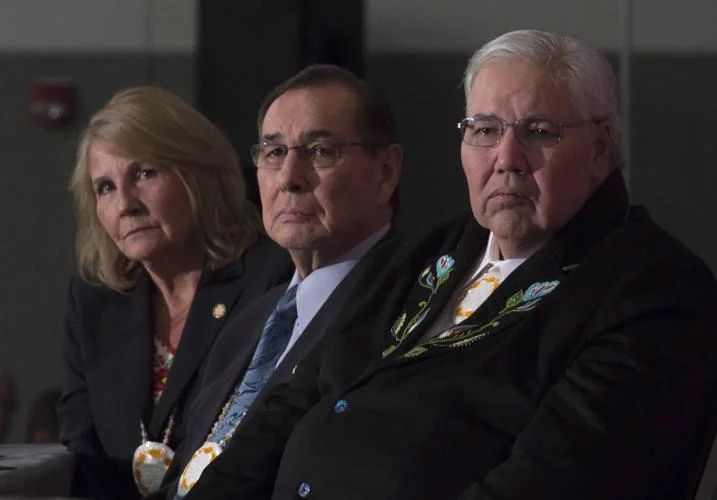
Littlechild says Carney's economic reconciliation approach ignores Indigenous rights
The former TRC co-chair says the government is sidelining treaty rights and traditional economies to fast-track major projects.
OTTAWA — Former Truth and Reconciliation Commission co-chair Wilton Littlechild says Prime Minister Mark Carney's focus on economic reconciliation is ignoring Indigenous rights and sidelining traditional economies.
"Right now, it’s like a four-legged stool with one leg missing," Littlechild said in an interview with The Canadian Press. That missing leg, he said, is true respect for Indigenous rights.
Littlechild, who co-chaired the landmark commission, said economic reconciliation remains key to achieving reconciliation between Indigenous and non-Indigenous Canadians, but not in the way Carney's government is pursuing it.
READ MORE: Liberals' major projects bill passes first vote with Conservative support
READ MORE: Federal government to table 2026 budget on Nov. 5
He said Carney has been focused on securing overseas investments while fast-tracking legislation that allows for quicker project approvals and environmental reviews.
"(Carney is) approaching things by violating treaty rights, by violating the United Nations Declaration on the Rights of Indigenous Peoples, and just steamrolling on national interest strategies that completely exclude us by way of disrespect," he said.
The federal government's Bill C-39, known as the Building Canada Strong Act, seeks to approve projects within one year.
First Nations chiefs say they worry that will severely compress the timeline for their communities to complete land-use assessments and consultations.
Similar legislation introduced by Ontario Premier Doug Ford's government is being challenged by Indigenous and environmental groups in court.
Indigenous Services Minister Mandy Gull-Masty disagreed with the suggestion that Carney does not prioritize Indigenous rights or the social issues faced by communities.
"There is a lot of institutional reconciliation that’s happening," Gull-Masty told The Canadian Press, citing work on reforming child and family services.
Hayden King, executive director of the Yellowhead Institute, said First Nations are still waiting for the government to pass clean drinking water legislation, improve health care access, address the crisis of missing and murdered Indigenous women and girls, and reduce incarceration.
"All I’ve heard Carney talk about is resource development," King said.
King said Carney's approach to relations with Indigenous communities puts him more in line with former prime minister Stephen Harper than with Justin Trudeau.
"Where Harper was the stick, Carney is the carrot," King said.
The "carrot" approach can be seen in how Carney's cabinet is encouraging First Nations to back the Trans Mountain pipeline through a low-cost loan and a $2.5 million payment for willing investors that some are comparing to a bribe.
King said economic reconciliation can't be achieved until Indigenous groups no longer have to fight for their rights and their land in court.
"If we’re really interested in holding up sovereignty and jurisdiction, then we have to insist on consent, and consent means knowing all the details before we make decisions," he said.
National Day for Truth and Reconciliation
Carney is set to mark the National Day for Truth and Reconciliation in his home province of Alberta, where he will attend and deliver remarks at a morning event in Edmonton.
His appearance comes just one day before he's widely expected to confirm that a proposed pipeline to the West Coast will be designated as a project of national interest, according to a government source who spoke confidentially to iPolitics.
In Ottawa, Governor General Louise Arbour will join residential school survivors, Indigenous leaders and dignitaries at a national commemorative gathering on the parliamentary front lawn.
The Truth and Reconciliation Commission, which concluded in 2015, found the goal of residential schools was to erase Indigenous cultures.
Between 1857 and 1996, 150,000 Indigenous children were forced to attend church-run, government-funded schools.
The commission initially documented the deaths of 3,200 children, but experts say the actual number could be much higher.
Economic reconciliation is mentioned twice in the commission's 94 Calls to Action, which call for meaningful consultations and equitable access to jobs.
Littlechild said while Ottawa's focus has shifted to economic reconciliation, the commission's calls to action that touch more on social issues are languishing.
He said he fears traditional economies like hunting, fishing and trapping could be damaged by an aggressive approach to resource development.
"You may have the best ideas in the world but without a fundamental grounding and foundation to self-determination, you’re missing a very important part," Littlechild said.
With files from The Canadian Press, CityNews and iPolitics