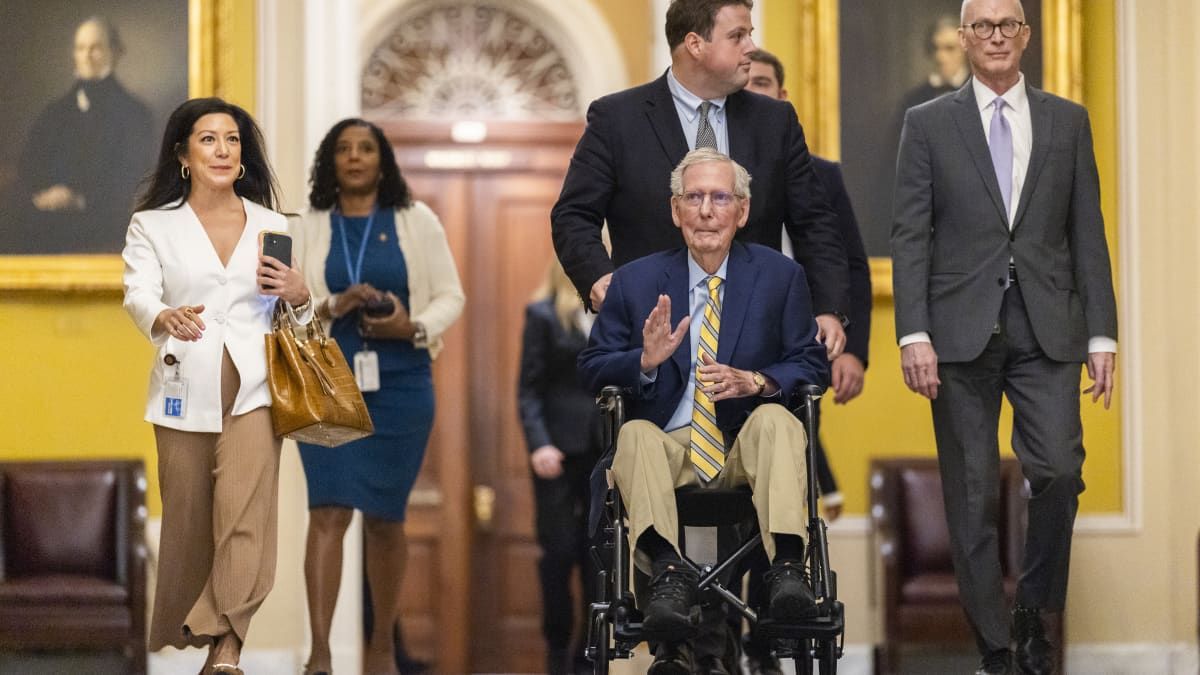
Sen. Mitch McConnell returns to Senate after three-month absence following hospitalization and fall
The 84-year-old Kentucky senator voted for the first time since his June fall, acknowledging ongoing health challenges from post-polio syndrome but pledging to participate in key votes during his final months in office.
Republican Senator Mitch McConnell made his carefully monitored return to the Senate floor on Monday, casting his first vote in three months since suffering a fall at his Kentucky home in June that left him briefly unconscious. The 84-year-old lawmaker, the longest-serving Senate leader in U.S. history, appeared visibly frail as he addressed reporters from a wheelchair, speaking slowly and with noticeable difficulty during his first public appearance since the hospitalization.
Extended absence sparks health concerns
McConnell's three-month absence from Senate duties generated intense speculation about his condition, compounded by his initial silence about the severity of his injuries. The senator eventually revealed in July that he had been "briefly unconscious" from the fall and required treatment for mild pneumonia during his hospitalization. A subsequent statement from the Capitol physician disclosed McConnell had suffered multiple falls this year related to his post-polio condition, though comprehensive medical evaluations found no fractures, cardiac abnormalities, stroke, tumor, or hemorrhage.
His physical therapy regimen focuses specifically on reducing fall risks associated with his post-polio syndrome, a condition affecting polio survivors decades after initial infection. The medical team described his recovery process as particularly challenging due to these pre-existing mobility issues, noting in their July assessment that it had been "a long and often frustrating process" for the senator.
Commitment to complete final term
Before addressing reporters in the Senate hallway, McConnell released a statement acknowledging his ongoing health limitations while affirming his determination to fulfill his senatorial duties through January.
"I've assured Leader Thune that, as I continue with physical therapy on the advice of my doctors, I will do my best to be present for tough votes when our Conference needs me,"McConnell wrote. He specifically mentioned legislative priorities including the pending farm bill and continued NATO support for Ukraine, stating he returned to "back up our good friends who are totally in the fight against the Russians."
Senate staff imposed unusual restrictions on media coverage of McConnell's remarks, prohibiting video recording of the event despite the second-floor hallway typically allowing such coverage. Only still photography was permitted during the brief appearance where McConnell joked about his prolonged absence from questioning, saying he wasn't sure how many reporters would show up "after dodging so many questions" during his nearly two decades as leader.
Growing scrutiny of aging leadership
McConnell's health struggles and visibly diminished capacity have amplified national conversations about advanced age among congressional leaders. Kentucky Governor Andy Beshear, a Democrat, took the extraordinary step during McConnell's absence of issuing a public letter urging greater transparency about the senator's condition, reflecting broader public concerns about lawmakers' ability to perform demanding duties.
This episode marks the latest in a series of health incidents for McConnell, who suffered a concussion from a March 2023 fall in Washington and later experienced two troubling freezing episodes during news conferences where he stared vacantly for extended periods before colleagues intervened. The senator also sprained his wrist last year after falling outside a Republican luncheon, with each incident drawing increased attention to his physical condition.
Legislative consequences of absence
The three-month vacancy left by McConnell created tangible obstacles for Senate Republicans, who found themselves unable to advance a farm bill out of committee without his vote during the summer months. His return provides critical support for GOP leadership as they attempt to move forward on several legislative priorities including cryptocurrency regulation and college sports governance in the coming weeks.
As the party's former longtime leader (2007-2023) and current senior statesman, McConnell's institutional knowledge and procedural expertise remain invaluable assets during complex negotiations. However, his limited physical capacity suggests Republican leadership must prepare for his selective participation during these final months before his scheduled January retirement.
Historical health context
McConnell's current mobility challenges stem from childhood polio contracted in the early 1940s, before widespread vaccination eliminated the disease in the Western Hemisphere. His recent statement explicitly referenced how
"the lingering effects of childhood polio haven't made it any easier"during his recovery from the June fall. Post-polio syndrome, which affects approximately 25-40% of polio survivors decades after initial infection, typically manifests as progressive muscle weakness and fatigue that can contribute to increased fall risk.
First elected in 1984, McConnell rose through Republican ranks to become one of the most consequential legislative strategists of modern times, serving as both Majority and Minority Leader during his record-setting tenure. His physical decline has become increasingly apparent since stepping down from leadership last year, with the June fall representing the most serious in a sequence of health incidents.
Political succession in Kentucky
With McConnell's retirement imminent, Kentucky Republicans have nominated U.S. Representative Andy Barr as their preferred successor, while Democrats selected former state legislator Charles Booker for the competitive Senate race. McConnell has repeatedly stated his intention to complete his term despite health challenges, ensuring continuity through the 118th Congress while allowing both parties to campaign for his seat.
Broader implications for governance
McConnell's situation underscores the complex balance between respecting individual health privacy and ensuring transparency about elected officials' capacity to serve. The episode also highlights how single lawmakers' health issues can impact broader legislative agendas, as demonstrated by the stalled farm bill progress during McConnell's absence.
As one of 25 senators aged 70 or older currently serving - including several in leadership positions - McConnell's experience reflects growing questions about institutional accommodations for aging legislators and appropriate succession planning. His determination to complete his term despite visible physical challenges speaks to both the dedication and potential vulnerabilities inherent in long congressional careers, setting the stage for continued discussion about age and capability in American politics.