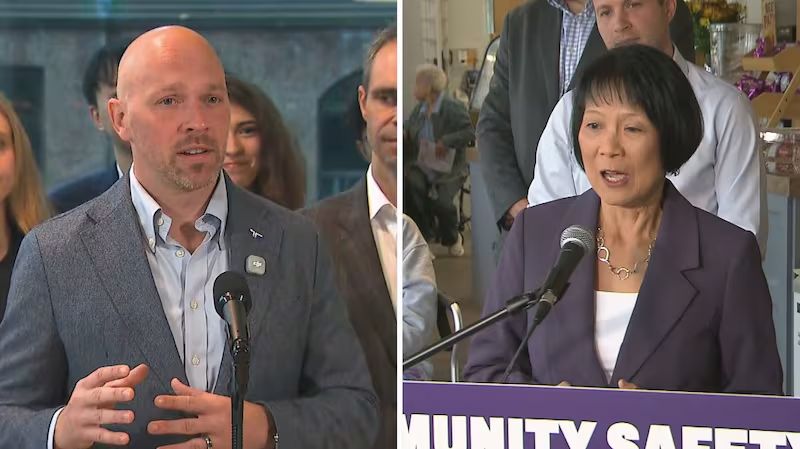
Brad Bradford narrowly leads Olivia Chow in new polls days before Toronto vote
Two new polls show challenger Brad Bradford with a slight edge over Mayor Olivia Chow among decided voters.
TORONTO — Two new polls show challenger Brad Bradford with a slight edge over Mayor Olivia Chow among decided voters, with less than a week to go before Toronto's Oct. 26 mayoral election.
Among decided voters, a Mainstreet Research poll gave Bradford 48.9 per cent support to Chow's 47.5 per cent, while a Build Canada poll found 48 per cent for Bradford against 44 per cent for Chow.
"This race is truly too close to call, but Bradford now has the upper hand," said Quito Maggi, president and CEO of Mainstreet Research.
READ MORE: Olivia Chow leads Brad Bradford by six points in Toronto mayoral race poll
READ MORE: Chris Alexander drops out of Toronto mayoral race, setting up Chow-Bradford showdown
A separate poll from Liaison Strategies also placed Bradford ahead with 49 per cent support to Chow's 47 per cent among decided and leaning voters, a result the firm called a "statistical dead heat."
"The order has changed, but this is not a result either campaign can treat as a clear lead," said Liaison Strategies principal David Valentin.
Both candidates downplayed the polls on Tuesday.
"The only poll that will matter is the one on election day," Chow said. "It's the people that count, not the polls."
Bradford said the numbers indicate residents want change, but that it's still an "extremely tight" race.
"If you want to change the city, you have to change the mayor. So, I think you're seeing that reflected in some of the polls," he said.
Maggi said the race represents a "seismic shift" as Chow had led in most polling throughout October.
"This race will come down to turnout and get-out-the-vote efforts from these campaigns," he said. "Bradford continues to lead among older voters who are more likely to vote, so he maintains that advantage."
The Build Canada poll also asked about priorities for the next municipal government, with 67 per cent of respondents saying the city should try new ideas even if some fail.
Most of those polled, 55 per cent, said City Hall moves too slowly when making decisions.
The poll also found widespread dissatisfaction with property taxes, with 37 per cent of respondents saying they get "very poor value" for their property taxes.
On the campaign trail Tuesday, Chow returned to an apartment building at 500 Dawes Road in Bradford's ward, a site where she sent city bylaw officers to complete emergency repairs in May.
"If you cannot represent your own people in your own ward, and do your job properly as councilor, you don't deserve to be mayor of the city of Toronto," Chow said.
Bradford's campaign fired back, stating Chow waited until an election year to take real action at the building.
Bradford focused on transit, promising to eliminate reduced speed zones, known as TTC slow zones, if elected.
"As mayor, I'm going to set the target at zero," Bradford said. "If you want a city that respects your time, respects your commute, then you have to vote for it."
Chow's campaign responded in a news release, stating that as a TTC commissioner, Bradford supported budgets that allowed preventative maintenance to stop.
Advance voting turnout is far higher than in recent elections. Over six days this month, 222,550 eligible votes were cast in advance polls, almost double the nearly 130,000 advance votes in the 2023 election.
The Mainstreet poll was conducted Oct. 16 through Oct. 18 with 1,000 adult Toronto residents and has a margin of error of 3.1 percentage points, 19 times out of 20. The Build Canada survey of 991 Toronto adults was conducted between Oct. 11 and Oct. 16 with the same margin of error.
Nosy Mag reported in October that Chris Alexander dropped out of the race, leaving Chow and Bradford in a two-person contest.
With files from The Canadian Press, National Post and CBC News