Pacific Link pipeline designated as project of national interest
The federal and Alberta governments will fast-track the Pacific Link pipeline to carry oil to the B.C. coast.
Analysis
Prime Minister Mark Carney and Alberta Premier Danielle Smith announced Thursday that the proposed Pacific Link oil pipeline has been designated a project of national interest, fast-tracking its regulatory process.
"For too long, we’ve watched projects with enormous transformative potential get mired down in uncertainty and delay. And today, we’re turning the page," said Smith in Fort McMurray, calling the pipeline "generational nation-building infrastructure."
READ MORE: Defence minister touts $8B military spending in Alberta ahead of referendum
READ MORE: Littlechild says Carney's economic reconciliation approach ignores Indigenous rights
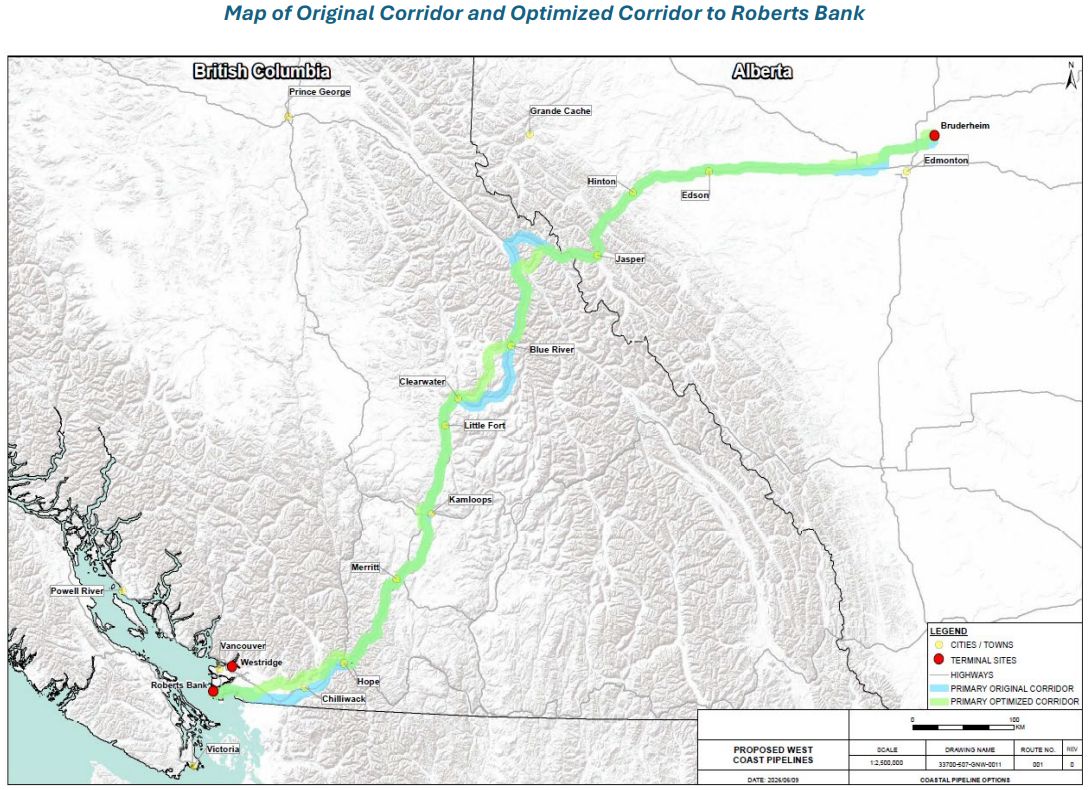
The 1,200-kilometre pipeline would carry one million barrels of crude oil per day from Bruderheim, Alta., to a new terminal at Roberts Bank, B.C., south of Vancouver.
Carney said the designation under the Building Canada Act moves the focus from whether to build the pipeline to how to build it.
"Before the Building Canada Act, proponents would have to spend years and potentially billions of dollars doing this work before even knowing where the federal government stood on the project," Carney said.
"Now, the federal government is making its position clear at the beginning of the process, rather than at the end."
Ownership structure and costs
The estimated construction cost is between $35.2 billion and $43.7 billion.
The federally owned Trans Mountain Corporation and the Alberta Petroleum Marketing Commission would each own 45 per cent, while Pembina Pipeline Corporation holds a 10 per cent stake during construction with an option for another 10 per cent later.
Indigenous communities will be offered a minimum 10 per cent ownership stake, according to Carney.
A senior government official said the early regulatory process is estimated to cost $4 billion, to be provided by the Alberta and federal governments.
Carney said the Canadian taxpayer will make money from the pipeline, which he estimated could generate an additional $6 billion to $10 billion per year by narrowing the price differential for Canadian oil.
Another official said the pipeline itself is expected to boost Canada's GDP by up to $20 billion annually, with an additional $10 billion from charging higher prices by diversifying exports away from the U.S.
The federal government said the project will create up to 140,000 jobs.
Regulatory timeline and conditions
The Major Projects Office will begin its review in early 2027, with public hearings held by the Canada Energy Regulator.
Dominic LeBlanc, the minister of one Canadian economy, is tasked with finalizing a conditions document by Sept. 1, 2027, which would allow construction to begin.
The goal is to have the pipeline operational by 2032-33.
Carney said consultations will determine environmental protections, oversight, Indigenous ownership and local hiring.
He said choosing a southern route avoids "highly sensitive ecosystems, including the Great Bear Sea," and that new federal funding for ocean protections will include measures to protect killer whale habitats during the port expansion.
A government explanatory note said the pipeline "does not directly contribute to Canada's greenhouse gas emission reduction targets" but is part of plans to reduce emissions intensity.
That plan includes the Pathways carbon capture project, which Carney said will absorb up to 16 million tonnes of emissions annually.
Smith said the agreement with Ottawa also secured the abeyance of federal clean electricity regulations and the suspension of the zero-emission vehicle mandate for Alberta.
Political and stakeholder reaction
Alberta Opposition Leader Naheed Nenshi said he advocated for a southern route and that the pipeline will create jobs.
"The hard part of getting this project completed begins. Nothing Danielle Smith has done shows she’s up to the task," Nenshi said, referencing the previous NDP government's work on the Trans Mountain expansion.
The Business Council of Alberta and the Canadian Chamber of Commerce welcomed the announcement for its potential to reach new markets.
Environmental groups were critical.
"New oilsands and pipeline projects will drive emissions even higher," the Pembina Institute said in a statement.
NDP Leader Avi Lewis accused the government of rushing the project "while sweeping aside environmental protections."
"This project leaves Canadians bearing all the risks of a bad investment without any of the rewards," Lewis said.
Conservative Leader Pierre Poilievre said his party strongly supports a pipeline and congratulated Smith for championing the project.
Government officials acknowledged the project will likely face court challenges, similar to the Trans Mountain expansion, but expressed confidence issues can be addressed through consultation.
The Major Projects Office consulted with more than 130 Indigenous communities over the last three months, though a government document said communities remain unsure of the project's success due to a lack of route-specific information.
Carney said the specifics of the project, including the final route, will be determined through those ongoing consultations.
With files from Edmonton Journal, CBC News and Global News