High-speed rail from Toronto to Quebec City could cost up to $113B, budget officer says
The Parliamentary Budget Officer's estimate is higher than the government's preliminary range of $60 billion to $90 billion.
OTTAWA — The cost to build a high-speed rail line from Toronto to Quebec City could range from $75 billion to $113 billion, according to a new report from the Parliamentary Budget Officer.
That estimate is higher than the preliminary range of $60 billion to $90 billion often cited by the federal government and Alto, the Crown corporation responsible for the project.
"This range reflects the considerable uncertainty inherent in large-scale rail infrastructure projects," the budget office's cost analysis said.
READ MORE: Alberta to seek private proposals for Calgary-Edmonton high-speed rail
READ MORE: Bank of Canada may raise interest rates next week for first time in three years
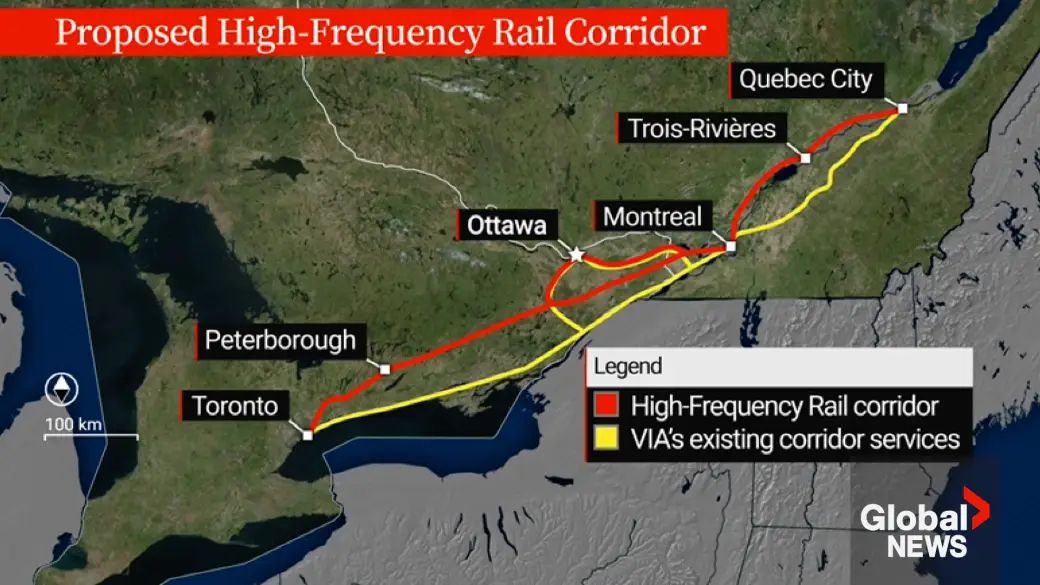
The report, released Thursday, was requested by the Senate finance committee to provide an independent assessment of the proposed Alto corridor, which promises travel between Toronto and Montreal in about three hours.
Parliamentary Budget Officer Annette Ryan said in a statement the report offers Parliament an independent look at the potential costs and economic effects of "one of the largest infrastructure projects ever proposed in Canada."
The analysis is based on a review of international high-speed rail projects and assumes a baseline route of approximately 850 kilometres, excluding a potential stop in Kingston, Ont.
Adding a stop in Kingston would increase uncertainty, the report notes, "due to the counter-balancing effects of easier geography for construction, but higher density of regional populations and greater ecological sensitivity."
The main cost drivers are tunnels and raised structures. The budget office said each additional kilometre of tunnel would add about $169 million, while an extra kilometre of raised structures would add $153 million.
Specific challenges include a planned 15-kilometre tunnel under Mount Royal linking Laval and downtown Montreal, and rock blasting through the Canadian Shield if the northern route between Peterborough, Ont., and Ottawa is chosen.
Transportation Minister Steven MacKinnon has said the southern route serving Kingston is the government's "strong preference," but that decision has not been formally confirmed.
The report suggests recent federal legislation meant to streamline approvals and expropriation processes could help avoid the major cost overruns seen in comparable American and British projects.
"While Canada’s legislative framework is intended to avoid the major cost-overrun drivers we’ve seen in comparable American and British projects, Canada’s route geography has some significant cost escalators, most notably tunnelling in and around Montreal, and the complexities of the Canadian Shield portion," Ryan said.
Philippe Archambault, a spokesperson for Alto, said the budget officer's analysis places the construction cost within a range "that is similar to and consistent with Alto’s working estimate," despite using different methodology.
"The development phase is ongoing and will confirm the route, refine cost estimates and finalize a rigorous business case before any final investment decision is made," he said in a statement.
Alto expects to release an initial version of that business case in the first half of 2027.
The budget office's figures only include construction costs, not operations. A future report will focus on ridership revenue and operational costs.
An internal document from 2023, previously reported by The Globe and Mail, estimated operating and maintaining the line would cost between $62.6 billion and $67 billion over 40 years, on top of construction.
That same document projected total revenue of $105 billion over 40 years, which would cover operational costs and offset some construction expenses.
Alto estimates ridership will reach 24 million passengers a year by 2055 and up to 43 million by 2084, a significant increase from the roughly 4.4 million passengers Via Rail carried in the corridor in 2025.
The report said construction of the first segment between Ottawa and Montreal would provide a modest economic stimulus, raising real GDP by approximately $1.8 billion in 2029 and increasing to $2 billion by 2033.
Employment gains from that segment would rise from about 4,300 to 9,000 jobs during construction, which could begin as soon as 2029 if the project receives final cabinet approval.
Alto is planning to release a more specific proposed route for the Ottawa-to-Montreal segment this year.
Conservative transport critic Dan Albas said the project should be cancelled.
"Canadians need fast, affordable and reliable transportation, not a Liberal high-speed rail boondoggle that drives up costs, delays construction and threatens the expropriation of productive farmland across Ontario and Quebec," Albas said in a statement on Thursday.
The Bloc Québécois has also raised concerns about expropriations and consultations for the project.
Nosy Mag reported in September that Alberta plans to seek private proposals for a Calgary-Edmonton high-speed rail line.
With files from CBC News, The Globe and Mail and CityNews