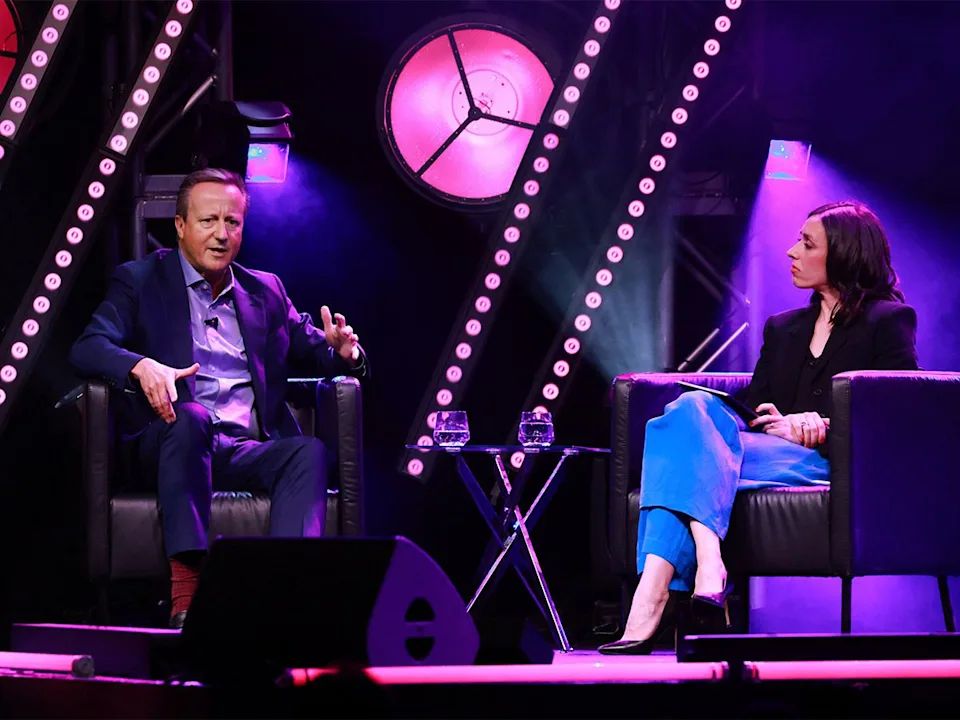
Former U.K. leader David Cameron says Alberta separation vote differs from Brexit
The former British prime minister, who oversaw the Brexit referendum, spoke at a Calgary conference three weeks before Alberta's vote.
CALGARY — Former British prime minister David Cameron says Alberta's upcoming referendum on separation is not comparable to the Brexit vote that led to his resignation.
Cameron made the comments at an energy leadership conference in Calgary on Monday, three weeks before Albertans vote on whether to pursue a binding vote on leaving Canada.
"I wouldn't compare what you're discussing here with the Brexit referendum," he said.
READ MORE: Poilievre to deliver unity speech in Alberta ahead of separation referendum
READ MORE: Carney urges Albertans to keep Canada united ahead of separation vote
"Brexit was about whether we wanted to stay in a trade association with an element of political union. I mean, Canada is not a trade association with an element of political union. Canada is an amazing country with an incredible history."
Cameron, who resigned in 2016 after Britain narrowly voted to leave the European Union, said he wishes he had spent more time negotiating with the EU before allowing a vote that took the outcome out of his hands.
He added that he failed to convince people to vote in favour of remaining in the EU, suggesting he didn't campaign forcefully enough for that side.
"We wanted to remain a sovereign, independent United Kingdom, but part of this association. My regret is that I failed to convince people that that was the best answer," Cameron said.
He also reflected on Scotland's 2014 independence referendum, which he said worried him more than Brexit because it threatened to break up the U.K.
"I was very nervous about it because if you have a referendum, you can't guarantee what the results are going to be," Cameron said.
Alberta Premier Danielle Smith, who has pointed to discontent over federal energy policy as the impetus for the Oct. 19 referendum, argued the conditions are different from Brexit.
She said the EU didn't work to solve the problems that motivated Britain's vote, but contrasted that with Ottawa's approach under Prime Minister Mark Carney.
"I see a major reach-out on the part of Ottawa to not only acknowledge but also address in a very serious way the issues that caused the tension in the first place," Smith said.
Carney, who was governor of the Bank of England at the time of the Brexit vote, has previously called Alberta's plan a "dangerous bluff" and pointed to parallels between the two referendums.
Polling shows roughly a quarter of Albertans would vote to hold a binding referendum on leaving Canada.
While separatists are expected to be defeated soundly next month, observers say voter turnout will play a major role.
Smith has said she's concerned voters may use the referendum to express frustration with Ottawa, and some separatist groups are advertising the vote as a means to extract concessions from the federal government.
Economic consequences
Despite the differences cited by Cameron, both votes carry clear economic implications.
Brexit reduced the U.K.'s GDP by up to eight per cent and lowered investment by as much as 18 per cent by 2025, according to estimates by Stanford University researchers.
A University of Calgary School of Public Policy study suggests Alberta separation would also carve a multi-billion-dollar hole in the province's economy.
Annual wages for a typical Alberta worker may drop by up to $12,000, with the province's GDP potentially falling by over 16 per cent if it separates, the study found.
An independent Alberta would also face costs of setting up a new country, estimated at anywhere from $50 billion to $170 billion in the first five years.
Randall Hansen, a political science professor at the University of Toronto, said Brexit and Alberta's referendum have numerous parallels, but that doesn't mean Alberta will immediately march down the same path.
"The Alberta conservatives ... cannot make the mistake the Tories made in the 80s, which is continually delegitimize the federation," Hansen said.
"That two-thirds can become 50 per cent, and the next time around you might end up in a situation that everyone would regret on both sides, which is Alberta leaving the federation."
Cameron stopped short of taking a position on Alberta's vote, noting that when former U.S. president Barack Obama made remarks during the Brexit campaign, "some people thought that this was foreign interference."
He did, however, make his view of Canada clear.
"To us in the U.K., Canada is not just any country," Cameron said. "Canada is one of our closest friends and partners. Our soldiers have fought together. Our scientists have invented things together. Our children study together."
Nosy Mag reported in September that Alberta's referendum campaign has revealed deep divisions with reports of vandalism, threats and emotional rallies.
With files from The Globe and Mail, Global News and CityNews