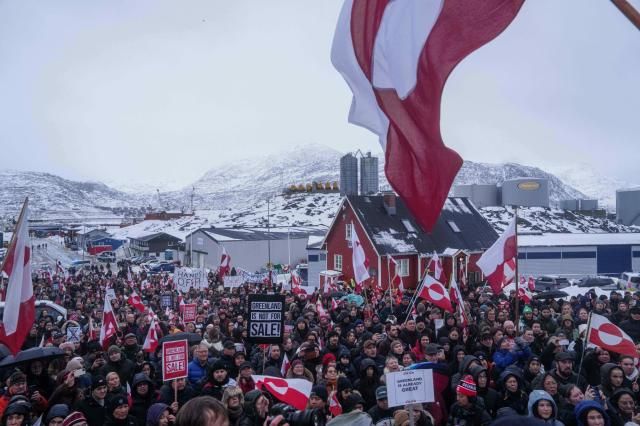
Trump announces military deal with Denmark to expand U.S. presence in Greenland
The U.S. and Denmark reached an agreement to strengthen American military operations in Greenland after months of tense negotiations over the strategic Arctic territory, with the deal addressing security concerns while maintaining Danish sovereignty.
President Donald Trump announced Friday that the United States has finalized a significant agreement with Denmark to expand American military operations in Greenland, concluding months of strained negotiations over the strategically vital Arctic territory. The deal marks a resolution to tensions that escalated when Trump previously suggested acquiring Greenland by force from the NATO ally.
Details of the military agreement
In a social media post announcing the pact, Trump stated the agreement provides the U.S. with "permanent control over security, and all other needs, in Greenland" while addressing what he characterized as "ALL of our many U.S. concerns." The president emphasized that development of an expanded military presence on the mineral-rich island would commence immediately under the terms of the deal.
A State Department official speaking on condition of anonymity revealed key provisions of the agreement, including prohibitions against establishing non-NATO military bases in Greenland, restrictions on investments from adversarial nations, and explicit bans preventing China or Russia from establishing military installations. Secretary of State Marco Rubio praised the arrangement as a "historic deal" and "huge win" for American national security interests in the Arctic region.
READ MORE: Experts question if Canada has enough diplomats for Arctic ambitions
Historical context of U.S.-Greenland relations
The agreement follows nearly a year of diplomatic tensions that began when Trump renewed his push for U.S. control over Greenland after returning to the White House. His demands escalated to threats of military action against the Danish territory, despite Greenland's population of approximately 56,000 residents repeatedly asserting their homeland was not for sale. These statements caused alarm among European allies and prompted condemnation from Russia.
Trump justified his aggressive stance by claiming Greenland's strategic importance for countering threats from Russia and China, though military analysts noted his repeated assertions about foreign military activity near Greenland's coastline lacked factual basis. The United States already maintains significant military infrastructure in Greenland through the Pituffik Space Base, established under the 1951 Defense of Greenland Treaty with Denmark.
Greenland's strategic military value
Positioned off Canada's northeastern coast with over two-thirds of its territory within the Arctic Circle, Greenland has held critical importance for North American defense since World War II. During the conflict, American forces occupied the island to prevent Nazi control and safeguard vital North Atlantic shipping lanes. Today, the U.S. continues to operate missile warning systems, missile defense capabilities and space surveillance operations from Greenlandic bases that support both American and NATO security interests.
Secretary Rubio framed the new agreement as permanently securing Greenland's role in what he termed "the strategic defense area of North America" while systematically excluding potential adversaries from gaining influence in the region. The deal formalizes Greenland's position in U.S. defense planning amid growing international competition for Arctic resources and shipping routes made increasingly accessible by climate change.
International response and diplomatic implications
Danish Prime Minister Mette Frederiksen stressed that the agreement "recognizes the sovereignty and territorial integrity" of both Denmark and Greenland while upholding their populations' right to self-determination. Greenlandic Prime Minister Jens-Frederik Nielsen acknowledged the deal's benefits for all three governments involved, particularly its recognition of Greenland's specific interests. The pact will receive formal signatures during next week's United Nations General Assembly meeting, though it still requires ratification by both the Danish and Greenlandic parliaments before taking full effect.
Imran Bayoumi, an associate director at the Atlantic Council's Scowcroft Center for Strategy and Security, highlighted how Trump's earlier threats to seize Greenland damaged America's standing among European allies. Bayoumi observed that many Europeans viewed the rhetoric as "a real attack on their sovereignty" that would require substantial diplomatic effort to overcome. The negotiated settlement may help mitigate some of that damage as Trump approaches midterm elections where foreign policy controversies have become a political liability.
Broader geopolitical significance
This agreement represents one of the Trump administration's few tangible foreign policy achievements following months of military interventions in Venezuela and Iran that contradicted the president's campaign promises of non-interventionism. By securing expanded military access through diplomatic channels rather than coercion, the White House can point to a legitimate strategic victory in an increasingly contested region.
The deal also reflects intensifying great power competition in the Arctic, where melting ice caps are creating new economic and military opportunities. While preserving Denmark's formal sovereignty, the agreement ensures American dominance over Greenland's security architecture at a time when both Russia and China are actively expanding their Arctic capabilities and influence. This development comes as climate scientists warn about accelerating environmental changes that could further transform Greenland's strategic importance in coming decades.
Implementation challenges ahead
Despite the announced agreement, significant hurdles remain before its provisions take full effect. The requirement for parliamentary approval in both Denmark and Greenland introduces potential complications, as local lawmakers may seek modifications to protect their nations' interests. Additionally, the deal's long-term implementation will require sustained cooperation between governments that have recently experienced considerable diplomatic friction.
The agreement's success may ultimately depend on whether the Trump administration can maintain constructive engagement with Danish and Greenlandic officials after years of confrontational rhetoric about the territory's status. As Arctic competition intensifies, all parties will need to balance military priorities with environmental concerns and the rights of Greenland's indigenous population.