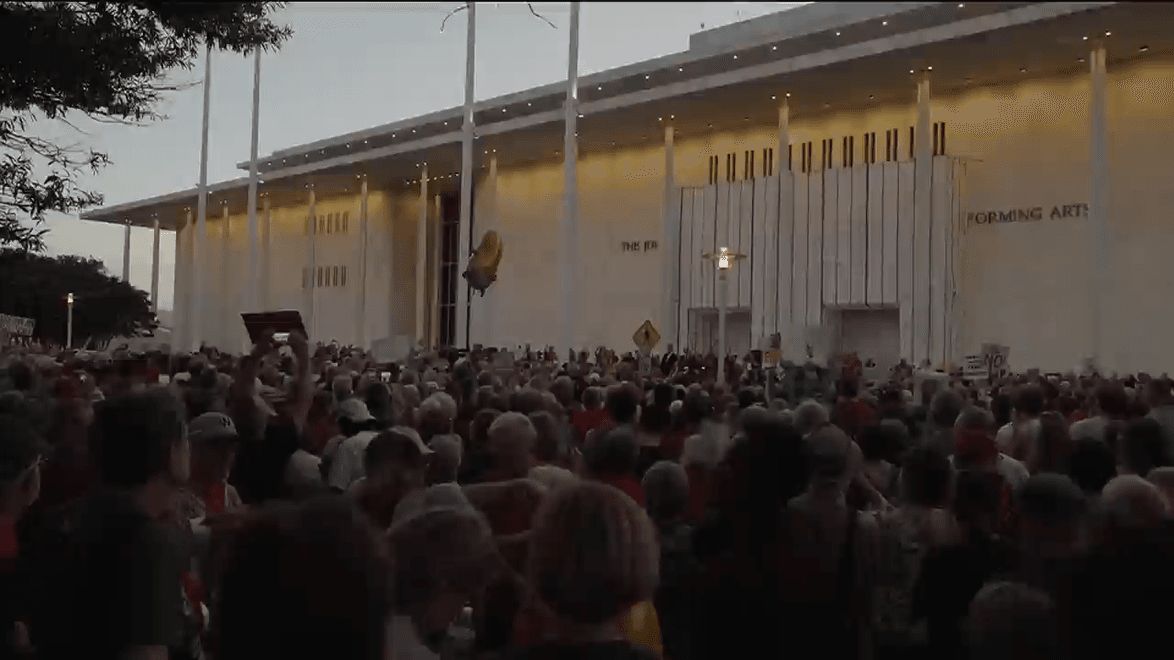
Thousands protest outside Kennedy Center amid fears Trump may demolish historic venue
Protesters formed a human chain around Washington's Kennedy Center as legal battles escalate over Trump's push to rename and potentially demolish the performing arts landmark.
Thousands of demonstrators surrounded Washington's John F. Kennedy Center for the Performing Arts on Friday evening in a mass protest against President Donald Trump's controversial plans for the cultural institution. The "Hands Around the Kennedy Center" event saw participants form human chains and carry signs opposing what organizers characterize as an existential threat to one of America's most revered arts venues. The protest comes amid escalating legal battles and growing fears that the administration may attempt to demolish the landmark despite court orders.
Legal battles over cultural control
The protest followed a week of dramatic legal developments in federal court where judges issued multiple rulings against the Trump administration's efforts to exert control over the Kennedy Center. U.S. District Judge Christopher Cooper first blocked the administration's attempt to restore Trump's name to the building on Tuesday, reaffirming his earlier ruling that the initial name change violated legal protocols. The judge's Thursday order imposing a 30-day notification requirement for any major physical alterations represents an extraordinary judicial intervention, signaling deep concerns about the administration's intentions toward the cultural landmark.
These legal safeguards haven't fully reassured protesters, who point to the administration's pattern of disregarding institutional norms. Chris Raleigh, co-founder of the organizing group Hands Off the Arts, expressed particular concern that Trump might circumvent court orders, citing the sudden demolition of the White House East Wing as precedent. "We got up one morning and there was a giant hole there," Raleigh told CityNews. His observation about the Kennedy Center's higher public profile suggests organizers believe the venue's visibility might offer some protection against unilateral action.
READ MORE: Vladimir Guerrero Jr. apologizes for comments about $500M Blue Jays contract
The heart of Washington's arts community
The protest highlighted how deeply the Kennedy Center is woven into Washington's cultural fabric. Local artist Bud Wilkinson's interactive protest piece - a chalkboard covered in Trump's name that attendees erased and replaced with heart symbols - became a powerful metaphor for the community's resistance. "This is not just about putting the president's name on the Kennedy Center," Wilkinson explained. His comments reveal how the controversy has become about more than nomenclature, representing broader concerns about artistic censorship and the politicization of cultural institutions.
The venue's educational partnerships demonstrate its role as more than a performance space. Alina Baciu's account of her daughter's experience at the Duke Ellington School of the Arts illustrates how the center serves as a vital resource for young artists. The loss of opportunities to borrow Washington National Opera costumes and perform on the Millennium Stage represents tangible damage to arts education that extends beyond the current political conflict. "All of those things have gone away because of this craziness," Baciu said, her words capturing the human cost of institutional instability.
Administration's pattern of cultural confrontation
The White House has maintained its aggressive posture toward cultural institutions despite legal setbacks. Trump's Oval Office comments framing his intervention as an attempted rescue of a financially troubled institution reveal his transactional view of cultural stewardship. His suggestion that support should be contingent on "recognition" underscores how fundamentally his approach differs from traditional understandings of public arts funding as serving broader civic purposes rather than personal or political gain.
The Kennedy Center conflict represents merely the most visible example of the administration's broader pattern of cultural confrontation. Court documents reveal parallel efforts to construct a Trump-branded triumphal arch and take control of the East Potomac Golf Links and U.S. Institute of Peace. What makes these cases particularly concerning to legal observers is the administration's willingness to begin work on projects while related litigation remains unresolved, challenging conventional understandings of how government operates under legal constraints.
Historical echoes in contemporary protest
The scale and symbolism of Friday's protest reflect how the Kennedy Center has become a flashpoint in larger cultural battles. Longtime volunteer Laura Steinberg's comparison of the demonstration to the Tiananmen Square protester facing down tanks may seem dramatic, but it reveals how participants view the stakes. Her declaration that "I'll stand in front of the wrecking ball if it's going to come to that" captures the depth of commitment among the center's supporters.
Steinberg's observation about the East Wing demolition's psychological impact helps explain the protest's urgency. The administration's demonstrated willingness to act unilaterally against historic structures has shattered assumptions about institutional protections. "Nobody thought he would actually do it," she observed, articulating how the demolition changed perceptions about what might be at risk.
Broader implications for cultural preservation
The Kennedy Center standoff represents a test case for how American society balances cultural preservation against executive authority. The protest's size and passion suggest Trump may have underestimated public attachment to institutions that embody national identity beyond partisan politics. The conflict raises fundamental questions about whether cultural landmarks should be understood as belonging to the public or being subject to the whims of temporary occupants of political office.
The administration's pattern of pursuing controversial projects despite legal challenges extends beyond the Kennedy Center, creating concerns about the erosion of institutional safeguards. As cultural institutions become political battlegrounds, the Kennedy Center conflict may establish precedents affecting how America preserves its shared heritage against political winds. The outcome could influence whether future administrations feel emboldened to treat cultural landmarks as disposable or view them as protected public trusts requiring bipartisan stewardship.
International context of cultural battles
The Kennedy Center protest occurs against a backdrop of global concern about the erosion of multilateral institutions and cultural protections. Prime Minister Mark Carney's upcoming attendance at the United Nations General Assembly, where Trump's efforts to dismantle the multilateral order will be a central concern, highlights how cultural preservation intersects with broader geopolitical stability. The administration's simultaneous announcement of a military agreement with Greenland after months of threats to seize the territory demonstrates a pattern of using cultural and geopolitical assets as bargaining chips.
These parallel developments suggest the Kennedy Center conflict is not an isolated incident but part of a larger pattern of challenging established norms around cultural stewardship and institutional preservation. As protesters demonstrated Friday, the arts community and its allies appear ready to make this a defining battle over what values will shape America's cultural landscape.