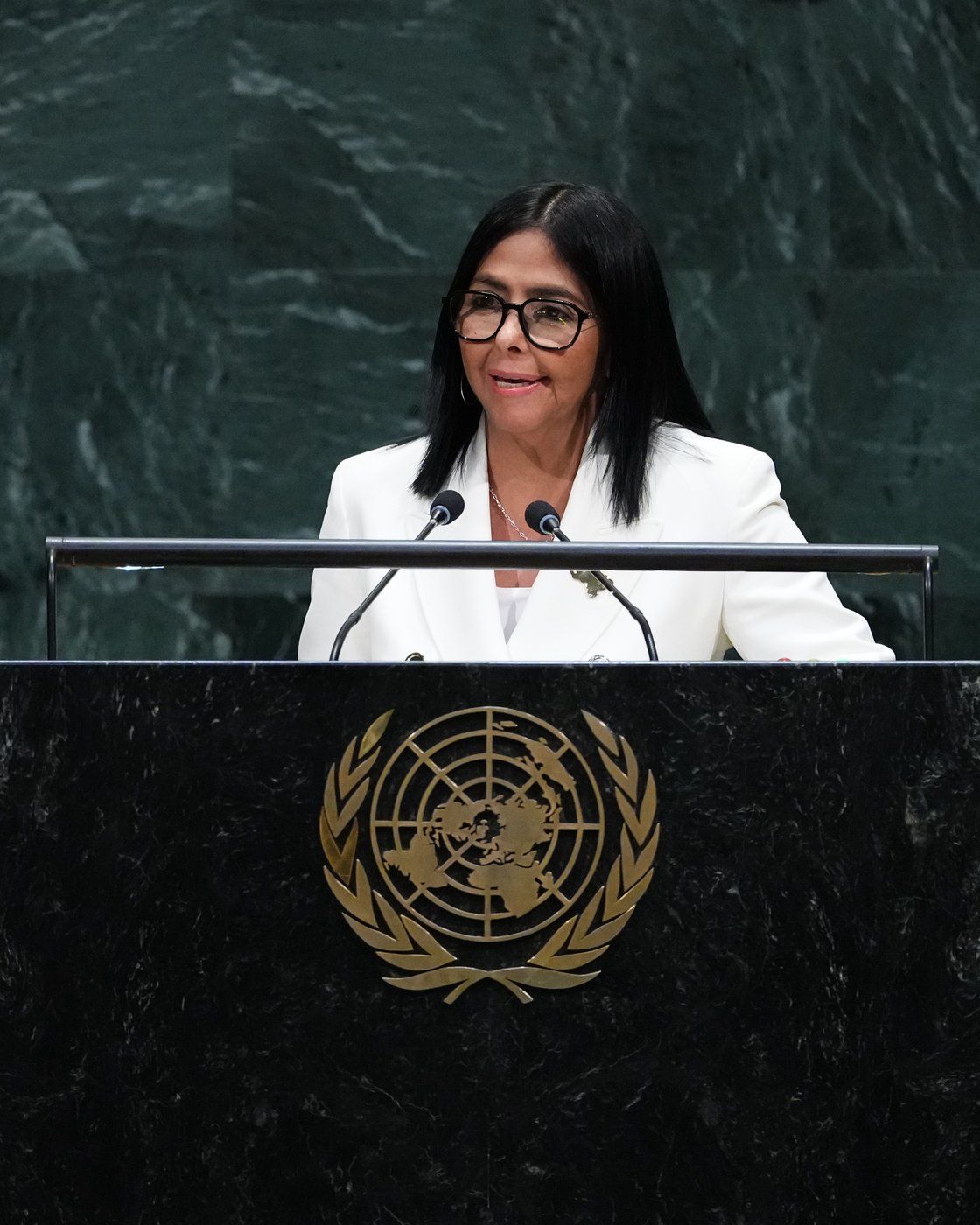
Venezuela's Acting President Delcy Rodríguez Commits to Future Elections in Milestone UN Address
Venezuelan acting president Delcy Rodríguez pledges elections will occur at a time determined by the Venezuelan people during her first UN General Assembly speech, marking a diplomatic turning point after Nicolás Maduro's capture. She outlines national recovery plans following devastating earthquakes while handling complex relations with the United States.
Venezuela's political landscape reached a pivotal moment as acting president Delcy Rodríguez delivered her maiden speech to the United Nations General Assembly on Wednesday. Her address represented both a symbolic and substantive shift in Venezuela's international standing following the dramatic capture of former leader Nicolás Maduro. Rodríguez carefully balanced democratic commitments with pragmatic diplomacy while acknowledging the nation's multiple ongoing crises.
A Carefully Worded Election Commitment
Rodríguez's most consequential declaration came when she addressed Venezuela's democratic future before the global assembly.
"Elections will be held in Venezuela,"she stated unequivocally, marking the clearest electoral promise from the transitional government. However, her deliberate phrasing that the Venezuelan people would determine the "right moment" for elections introduced strategic ambiguity about timing, reflecting the delicate political calculations facing her administration.
The acting president revealed preliminary steps toward electoral preparation, noting her government had initiated
"political dialogue with opposition sectors"to establish what she described as a "process based on equal conditions for all." This outreach suggests recognition that restoring political credibility requires broader participation than under Maduro's polarized governance. Rodríguez emphasized institutional readiness as a prerequisite, pledging Venezuela's governing bodies would guarantee an "inclusive and transparent process" when elections occur - a direct response to longstanding international concerns about electoral integrity.
READ MORE: Anand to deliver Canada's UN speech as Carney skips address
READ MORE: Carney to attend UN General Assembly amid global tensions and Trump's trade threats
Diplomatic Thaw with the United States
Rodríguez's appearance at UN headquarters in New York carried profound diplomatic significance, representing Venezuela's most substantial reengagement with the international community since Maduro's 2018 UN visit. She underscored this symbolic shift by noting
"the last time that two presidents of Venezuela and the United States met was in 2009,"highlighting how profoundly relations had deteriorated before this tentative rapprochement.
Perhaps most surprisingly, Rodríguez extended public gratitude toward U.S. President Donald Trump for willingness to normalize relations, despite Washington's direct role in Maduro's capture. This diplomatic overture followed the April lifting of U.S. sanctions against Rodríguez herself, signaling American acceptance of her transitional government. Their private meeting during UN proceedings yielded discussions about bilateral cooperation in energy, mining, and security sectors - areas where both nations see potential mutual benefit despite their complicated history.
Governing in the Shadow of Maduro
The entire UN appearance unfolded with the unspoken presence of Nicolás Maduro, Rodríguez's former superior now imprisoned just miles from UN headquarters awaiting trial on drug trafficking charges. While avoiding direct commentary on Maduro's legal situation, the acting president acknowledged Venezuela had suffered recent
"setbacks"- a likely reference to both the controversial leadership transition and subsequent instability.
Rodríguez positioned her administration as breaking from past governance failures, asserting that
"interests alien to the common good of Venezuelans were imposed"during previous leadership. This indirect critique of Maduro's tenure stopped short of direct condemnation, reflecting the sensitivity surrounding her rise to power through what many view as foreign intervention. Her rhetoric emphasized national reconciliation over recrimination, framing current challenges as opportunities to rebuild political institutions rather than dwell on past conflicts.
Addressing Dual Crises: Political and Natural
The acting president devoted significant attention to Venezuela's June earthquake disaster, which compounded existing political and economic difficulties. The twin seismic events - measuring 7.2 and 7.5 in magnitude - devastated north-central regions, killing over 6,500 people and leaving widespread destruction. Rodríguez connected national recovery efforts to her diplomatic outreach, suggesting international cooperation could play a vital role in reconstruction while allowing Venezuela to maintain sovereignty over the process.
Her declaration that
"Today, Venezuela is being reborn"sought to project optimism despite acknowledging the long road ahead. Rodríguez cautioned citizens that recovery would require patience and unity, describing the path forward as neither quick nor easy. This tempered optimism reflects the administration's challenge in managing expectations while maintaining public confidence during multiple overlapping crises.
Energy Diplomacy as Economic Stabilization
Rodríguez positioned Venezuela's vast oil reserves as central to both economic recovery and diplomatic reengagement. She highlighted recent agreements providing U.S. interests a stake in Venezuela's oil industry as mutually beneficial arrangements that would modernize infrastructure while generating crucial revenue. These partnerships represent a pragmatic approach to leveraging national resources for immediate needs, while carefully framing them as sovereign decisions rather than concessions to foreign powers.
The acting president described these energy collaborations as part of a broader strategy to
"pave the way for cooperation in the energy sector, the promotion of security, the joint fight against transnational crime, and economic cooperation for the benefit of both peoples and our continent."This multifaceted approach suggests recognition that Venezuela's challenges require coordinated solutions across economic, security, and social spheres.
Handling Transitional Governance
Rodríguez's speech revealed the complex balancing act required of her transitional government. As Maduro's former vice president now leading the country after his extradition, she must establish legitimacy both domestically and internationally while distancing herself from problematic aspects of the previous administration. Her emphasis on
"rebuilding the national soul"as a priority acknowledges the profound social divisions and institutional damage requiring repair.
The acting president's vow to shoulder
"historic responsibility"reflects awareness that her administration represents a bridge between Venezuela's troubled recent past and an uncertain future. Her insistence that
"Venezuela wants to breathe freely and exercise its rights as a sovereign nation without any kind of interference"simultaneously asserts independence while subtly addressing criticisms about the circumstances of her rise to power.
Prospects for Democratic Transition
Rodríguez's UN debut marks a potential inflection point in Venezuela's political trajectory. While her election commitment lacks concrete timelines, it establishes an official framework for democratic restoration that international observers can monitor. The success of her administration may hinge on translating diplomatic overtures into tangible improvements for Venezuelans facing political uncertainty, economic hardship, and earthquake recovery challenges.
The coming months will reveal whether Rodríguez can maintain this delicate equilibrium - advancing electoral preparations while stabilizing governance, pursuing international cooperation without appearing subordinate to foreign interests, and addressing past grievances while focusing on national reconciliation. Her ability to handle these competing demands will determine whether Venezuela's current transitional phase leads to genuine democratic renewal or becomes mired in continued political turbulence.