Poilievre proposes tax cuts on diesel to boost Canadian supply
The Conservative leader wants to extend a fuel excise tax cut and remove GST on diesel until at least next July.
Explainer
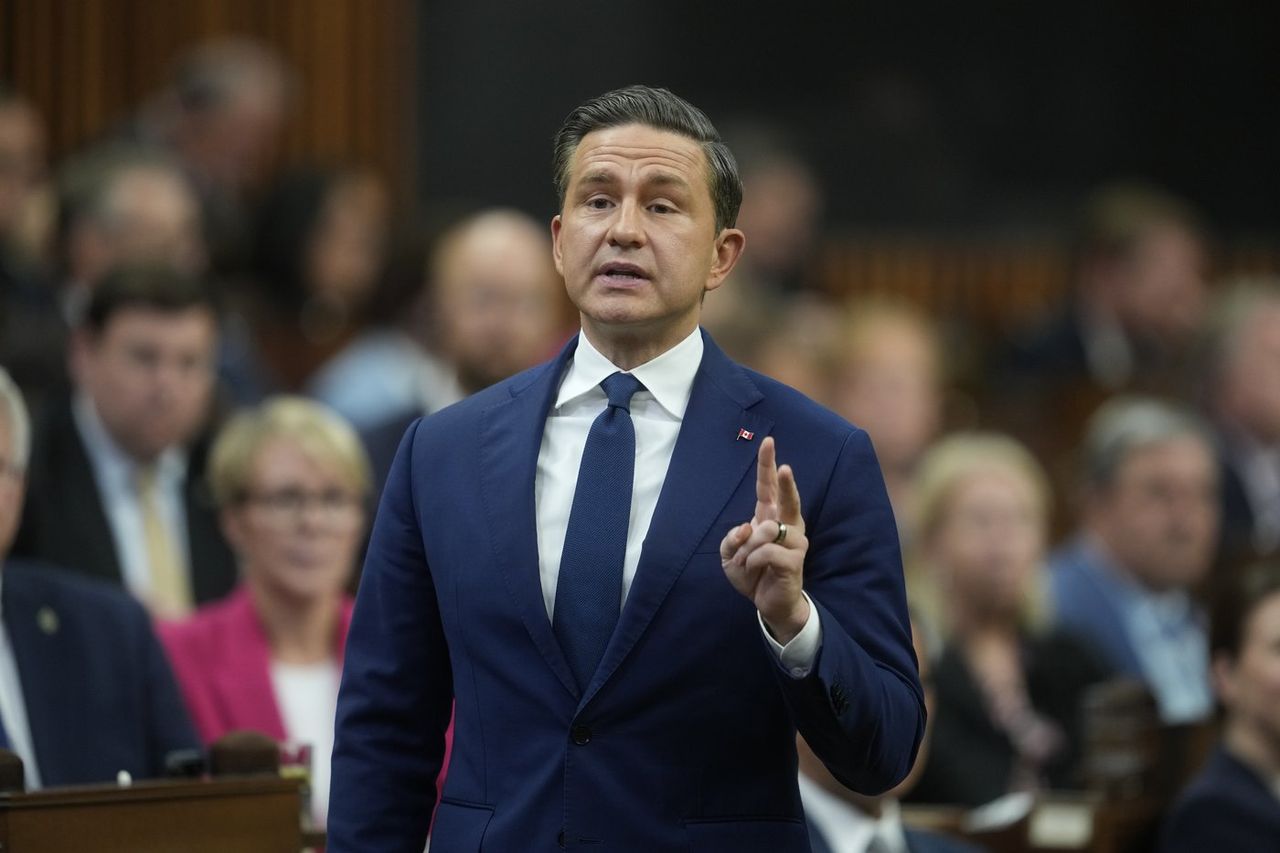
Conservative Leader Pierre Poilievre is pitching a plan to cut federal taxes on diesel fuel and help ensure Canada has affordable supplies of the fuel in the future.
He outlined the policy proposal on Sunday at a suburban Ottawa gas station.
READ MORE: Poilievre to deliver unity speech in Alberta ahead of separation referendum
READ MORE: Canada and allies regret Palestinian election delay
Poilievre says Canada already produces enough diesel to meet national demand, but transportation bottlenecks leave some regions dependent on U.S. imports.
He proposes eliminating all tax on diesel sales until at least Canada Day by extending the full fuel excise tax cut until July 1 of next year and removing the GST from the purchase of fuel.
Poilievre also advocates removing all diesel production taxes by permanently scrapping the federal industrial carbon tax and the Clean Fuel Standard.
He says the Clean Fuel Standard adds costs to the production of diesel and discourages new investment in refineries.
He says the Conservative plan would expand refining capacity, help refineries process more Canadian crude and build the transportation and storage infrastructure needed to supply every region.
What other recent calls have been made on fuel taxes?
The federal government will extend gas tax holiday into 2027.
Ontario Premier Doug Ford wrote to Bank of Canada Governor Mark Carney asking to extend gas and diesel excise tax holiday to Jan. 1.
What other events happened in Ottawa on Sunday?
Canadian flags were at half-mast and the skirl of bagpipes rung out as hundreds of police officers marched onto the lawn on Parliament Hill to honour those who have fallen in the line of duty.
The Canadian Police and Peace Officers’ annual memorial service on Sunday recognized five police officers and a correctional services officer who died this year.
Ontario Provincial Police officer Brandon Malcolm died in a single-vehicle crash in April while his colleague Tarun Bali was fatally struck by a car in June.
Two days after Bali was killed, Toronto police officer Marc Pinizzotto was fatally shot while executing a search warrant related to an alleged “gun-for-hire” scheme in Toronto.
The ceremony also commemorated Sûreté du Québec officer Anais Fortin-Cozzens who died in a car crash, and Montreal police officer Mohamed Benreouane, who was shot and killed in a gunfight that also claimed the lives of a civilian bystander and the alleged gunman.
Nicolae Serban, a correctional services officer who died in a crash while transporting an inmate, was also recognized.
Public Safety Minister Gary Anandasangaree said the ceremony is a chance to pay respects to fallen heroes, as well as their families who “paid the ultimate price for that sacrifice.”
Since the memorial service was first held in 1978, over 900 names have been added to glass tablets that line the perimeter wall on Parliament Hill.
What is the context for Arctic diplomacy mentioned in the notes?
As Canada plans an ambitious expansion of defence and economic activity in the Arctic, regional experts are asking whether it has enough diplomats to build the ties it wants in the North.
“The Arctic is a geopolitical hot spot,” said Natan Obed, president of Inuit Tapiriit Kanatami. “The (Global Affairs) department does not have huge bench strength when it comes to Arctic diplomacy.”
In 2023, the government of Prime Minister Justin Trudeau closed the Canadian International Arctic Centre, a hub for diplomacy across the region that had been operating within Canada's embassy in Norway since 2009.
In a briefing note obtained by The Canadian Press, Global Affairs Canada cited “high costs in Oslo” and anticipated savings of $550,000 per year.
“The hybrid work model has demonstrated the department's ability to engage worldwide through technology … diminishing the relative advantage of operational staff located in the field,” says the briefing note.
Artur Wilczynski, who served as Canada's ambassador to Oslo from 2014 to 2018, called the decision to close CIAC “incoherent.”
“You need to develop a cohort of people who actually have a deep understanding and knowledge of a very complex and diverse region,” he said. “You do not get that from a Zoom call.”
In December 2024, the Trudeau government released an Arctic foreign policy that committed to boosting domestic and international collaboration to face down emerging foreign threats.
The policy said the region was “no longer free from tension” because of increased geopolitical instability following Russia’s invasion of Ukraine.
Ottawa appointed Virginia Mearns as Arctic ambassador last year and promised new consulates in Greenland and Alaska.
In February, Foreign Affairs Minister Anita Anand opened Canada's first consulate in Greenland's capital, Nuuk.
Due to the shortage of available buildings, the Canadian consulate operates out of the Icelandic consulate.
A briefing document obtained by The Canadian Press estimates the operating cost of the consulate at $8.76 million over five years, roughly $1.75 million annually.
Global Affairs Canada said in a media statement, “These figures were prepared for planning purposes … and may be temporarily higher than the actual costs incurred during implementation due to a number of factors, including employing fewer staff than originally planned.”
The department did not say when the consulate in Alaska will open or how many staffers it will have.
This report by The Canadian Press was first published Sept. 27, 2026.
With files from The Canadian Press, CityNews and CBC News