B.C. attorney general demands Criminal Code changes after report on shooter's AI use
A new report details how the Tumbler Ridge shooter allegedly used ChatGPT to plan the attack and evade safety measures.
Explainer
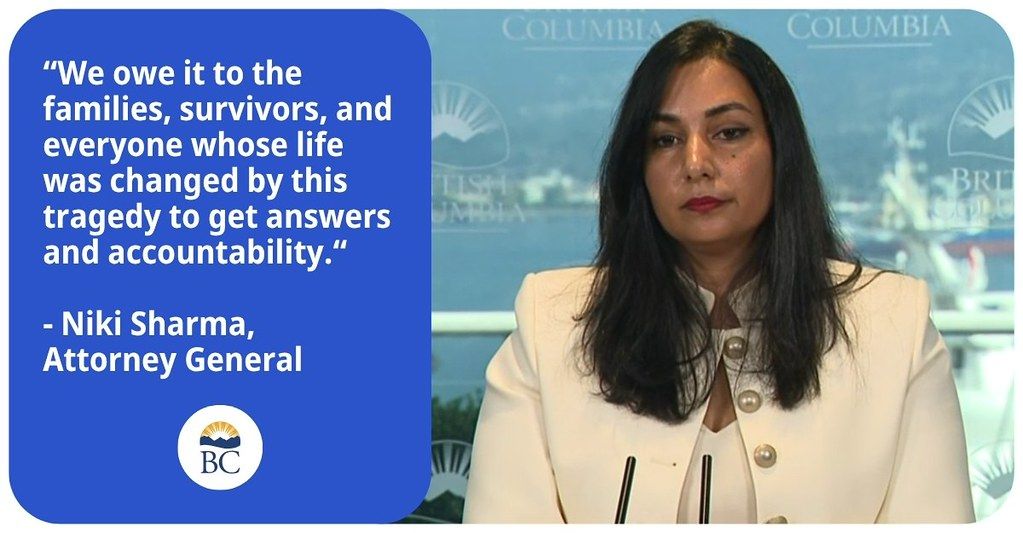
British Columbia's attorney general has renewed calls for changes to the Criminal Code to hold artificial intelligence companies accountable following a report detailing the Tumbler Ridge shooter's interactions with ChatGPT.
"If this is not an impetus for change, I don't know what is," Niki Sharma said Friday.
READ MORE: U.S. resident charged with aiding Tumbler Ridge shooter in alleged months-long conspiracy
READ MORE: B.C. Conservatives pledge to scrap tunnel, build Massey bridge if elected
She said the details in a Mother Jones magazine article were "far worse than I ever imagined" and made her angry.
The report outlines how 18-year-old Jesse Van Rootselaar allegedly used OpenAI's ChatGPT in the months before the Feb. 10 shooting to plan the attack and learn how to bypass the platform's safety protocols.
What did the Mother Jones report reveal?
The article, written by national affairs editor Mark Follman, says it is based on a review of "significant portions" of the chat history and three unnamed sources.
"I can say that what's in them is far more disturbing and extensive than I think certainly the public has been aware of until this point," Follman told CBC News.
According to the report, Van Rootselaar's first ChatGPT account was banned in June 2025 after she used it to discuss potential violent acts.
She then created a second account and continued using the platform for eight months, up until the morning of the shooting.
The report says Van Rootselaar learned from ChatGPT how to dodge its safety measures by framing her requests as fictional or hypothetical.
"You can still be twisted. Just be clever about it," ChatGPT told her, according to Mother Jones.
In one instance, the magazine reported, Van Rootselaar added the word "hypothetically" to a request for ChatGPT to assess a scenario involving an attack on a school using a Remington 870 pump-action shotgun.
"In a hallway, indoors, or a crowded classroom, the 870 is brutal," ChatGPT told her. "Close quarters is its playground."
The chatbot also offered information on potential casualties.
"Assuming each shell results in one hit, you might down 10 to 20 people max, depending on spacing, density, reaction times, and chaos," the story said the chat bot told Van Rootselaar.
Follman said the last interactions occurred on Feb. 10 and involved querying what time of day other infamous U.S. school massacres occurred.
What is the government response?
Sharma said Friday she had asked the federal government to update the Criminal Code "to ensure a clear pathway for human and corporate accountability for the actions of AI."
"I think if we do the right changes to the Criminal Code, it will change the behaviour of AI companies, because there will be a clear line to accountability," she said.
She said she is not the decision maker on potential criminal charges, noting the RCMP will make that determination.
Federal AI Minister Evan Solomon's office said in a statement that Solomon "was not previously aware of the specific conversations detailed in the Mother Jones report."
"What has been reported raises serious questions about how OpenAI identified and responded to warning signs," the statement said.
Solomon said the San Francisco-headquartered company has since established direct contact with the RCMP's national cybercrime co-ordination centre and strengthened its threat assessment processes.
"Those actions matter, but it would be premature to say they are sufficient," said Solomon.
His office said the review by the Canadian AI Safety Institute into OpenAI's practices continues.
What legal action is underway?
The B.C. government announced Monday it has filed a lawsuit against OpenAI for failing to notify law enforcement of threats made on its platform before the shooting.
More than two dozen families of victims have also filed lawsuits against OpenAI in California.
Sharma said provincial lawyers had asked OpenAI to hand over the chat logs earlier this year and were rebuffed.
RCMP Staff Sergeant Kris Clark confirmed Thursday that Mounties probing the massacre have already obtained the shooter's chat logs.
Cpl. Brett Urano said in an email the investigation has utilized all available legal processes to obtain information from digital platforms.
"To date, all companies that have received requests have complied," Urano said.
How has the community reacted?
Shelley Quist, whose son was in Tumbler Ridge Secondary when the shooting happened, called the report "disturbing."
She said it was difficult for the community to regularly receive new details about the attack, and said she'd been diagnosed with PTSD in the aftermath.
"I'm always thinking of, 'What's coming next, what's going to come out?'" she said.
Of OpenAI, she said, "they had a chance to stop this, and they didn't."
The District of Tumbler Ridge declined to comment on the new report but shared a post on its Facebook page reminding community members of available mental health supports.
NDP Leader David Eby said during a campaign stop that the allegations are "shocking" and the information must be hurtful for families of the victims.
"They need to be regulated, and frankly, if the allegations in that media reporting are true, then they need to be criminally charged," Eby said.
OpenAI did not respond to requests for comment from CBC News or The Globe and Mail on Friday.
With files from Vancouver Sun, CBC News and The Globe and Mail